
What Is Cryptocurrency? Clear Definitions, Types, and Stablecoin Safety

Do you ever feel a bit lost when you hear words like "crypto" or "blockchain"? You’re not alone. Lots of people wonder, "what is crypto meaning?" and get confused by all the new words. In 2026, it seems like everyone is talking about digital money, but it can still feel like a secret language.
Actually, understanding the real crypto meaning is very important. It’s more than just knowing about Bitcoin. Cryptocurrencies are digital money that use special computer tech called blockchain to keep things safe and private. This tech helps make transactions happen without needing a bank in the middle, meaning it’s a decentralized system [1, 2].
Among all the different kinds of crypto, stablecoins are getting a lot of attention. These are a special type of cryptocurrency that tries to keep a steady value, often by being linked to something stable like the US dollar [3]. This means they don’t jump up and down in price as much as other cryptos. Even so, it’s wise to learn how to check them out properly. Knowing the details about stablecoins is key to making smart choices, especially as new rules for them were put in place in 2025 [4].
The big problem for many folks and small businesses is all the technical words. It’s hard to know who to trust or how to tell if a digital coin is safe or risky. Sometimes, even experts use different words to mean the same thing, which makes it even harder to understand [5]. You need simple ways to figure things out for yourself. This way, you can avoid common mistakes and confidently manage your money in this new digital world.
Being able to properly inspect stablecoins and understand their risks means you can make better decisions for your cash management and maybe even start turning your life around with crypto. If you’re eager to learn more about how to check stablecoins for yourself, we have a helpful guide on stablecoin due diligence.

Want to keep learning about crypto in simple steps? The free Clicks and Trades newsletter can help you understand all the parts of the crypto world. It gives you clear guidance and safety tips.
Ready to make more sense of crypto and stablecoins?
Sign Up
What is cryptocurrency? Clear definitions and common misconceptions
Let’s clear up the fuzzy parts about crypto meaning. At its core, a cryptocurrency is a type of digital money. It lives only on computers, not as physical coins or paper bills. What makes it special is that it uses super strong computer code, called cryptography, to keep all transactions safe and sound. Think of it as a special kind of digital cash [1].
When people say "crypto" in everyday talk, they’re usually just shortening the word "cryptocurrency." But sometimes, "crypto" can also mean the wider world of digital assets, including things that aren’t exactly money but still use the same special computer tech. In 2026, this digital world is growing fast, with many new things like NFTs and digital art also falling under the big "crypto" umbrella.
The Big Ideas Behind Crypto
To really understand the crypto meaning, let’s look at a few key ideas:

- Decentralization: This is a fancy word that just means there’s no single boss. Unlike regular money where a bank or government controls everything, cryptocurrencies are managed by a network of computers around the world [2, 3]. No one person or company is in charge, which makes it a "trustless" system [4].
- Digital Ledger (Blockchain): Imagine a super-secure, endless record book that everyone on the network shares. This is what we call a blockchain. Every time someone sends crypto, that information is added to this digital book in a way that can’t be changed. It’s how crypto keeps track of who owns what and makes sure everything is fair [5].
- Tokens vs. Native Coins: This can get a little tricky, but it’s simple once you get it.
- Native Coins are the main currency for their own blockchain. Think of Bitcoin, the very first cryptocurrency, or Ethereum. These coins are built to run their specific network [6, 7]. For example, Bitcoin is the native coin of the Bitcoin blockchain. Understanding the pros and cons of these like bitcoin and cryptocurrencies advantages and disadvantages is a good first step.
- Tokens are different. They are usually built on top of existing blockchains, like apps are built on your phone’s operating system. They can represent many things, from digital collectibles to ways to vote in a digital community, or even stablecoins which we talked about before.
Common Crypto Misunderstandings
One big mistake people make is thinking all crypto is the same. Actually, there are thousands of different cryptocurrencies, each with its own purpose. Some are for quick payments, some are for earning rewards through a process called what is crypto staking, and others are for building complex digital applications [8].
Another misunderstanding is that crypto is only for tech wizards. The truth is, more and more tools are making it easier for everyday people to get involved.

Many find that learning about crypto can be a way of turning my life around with crypto, by opening doors to new ways of managing money and growing wealth.
As you explore this exciting world, knowing these basic crypto meanings will help you make smarter choices. If you want to keep learning about crypto in simple steps, the free Clicks and Trades newsletter can help. It offers clear guidance and safety tips, helping you avoid common mistakes and navigate the digital finance world with more confidence.
Ready to make more sense of crypto and stablecoins?
How cryptocurrencies work at a high level: blockchain, networks, and consensus
So, we know what cryptocurrency is: digital money kept safe with special computer code. But how does it actually do that? Let’s peel back another layer of the "crypto meaning" and see how it works behind the scenes.
Imagine cryptocurrency as a giant, never-ending digital train. Each train car is like a "block" of information. These blocks are chained together, one after the other, forming what we call a blockchain. This blockchain is the super-secure record book we talked about before [1]. Every time someone sends crypto, that information gets added to a new train car (a new block), and once it’s on the chain, it can’t be changed or removed. It’s truly a permanent record [2].
The Network: A Team of Computers
This digital train doesn’t run by itself. It needs many workers, or in this case, many computers. Thousands of computers all around the world are connected in a big network. Each of these computers has a copy of the entire blockchain [3].
When you send crypto to someone, it’s like shouting out "I want to send 1 Bitcoin to Jane!" to all these computers. They all hear it. This is how the decentralized nature of crypto really comes to life; no single company or government is in charge of checking your transaction [4].
Consensus: Everyone Agrees
Now, how do all these computers agree that your transaction is real and should be added to the next train car? This is where consensus comes in.
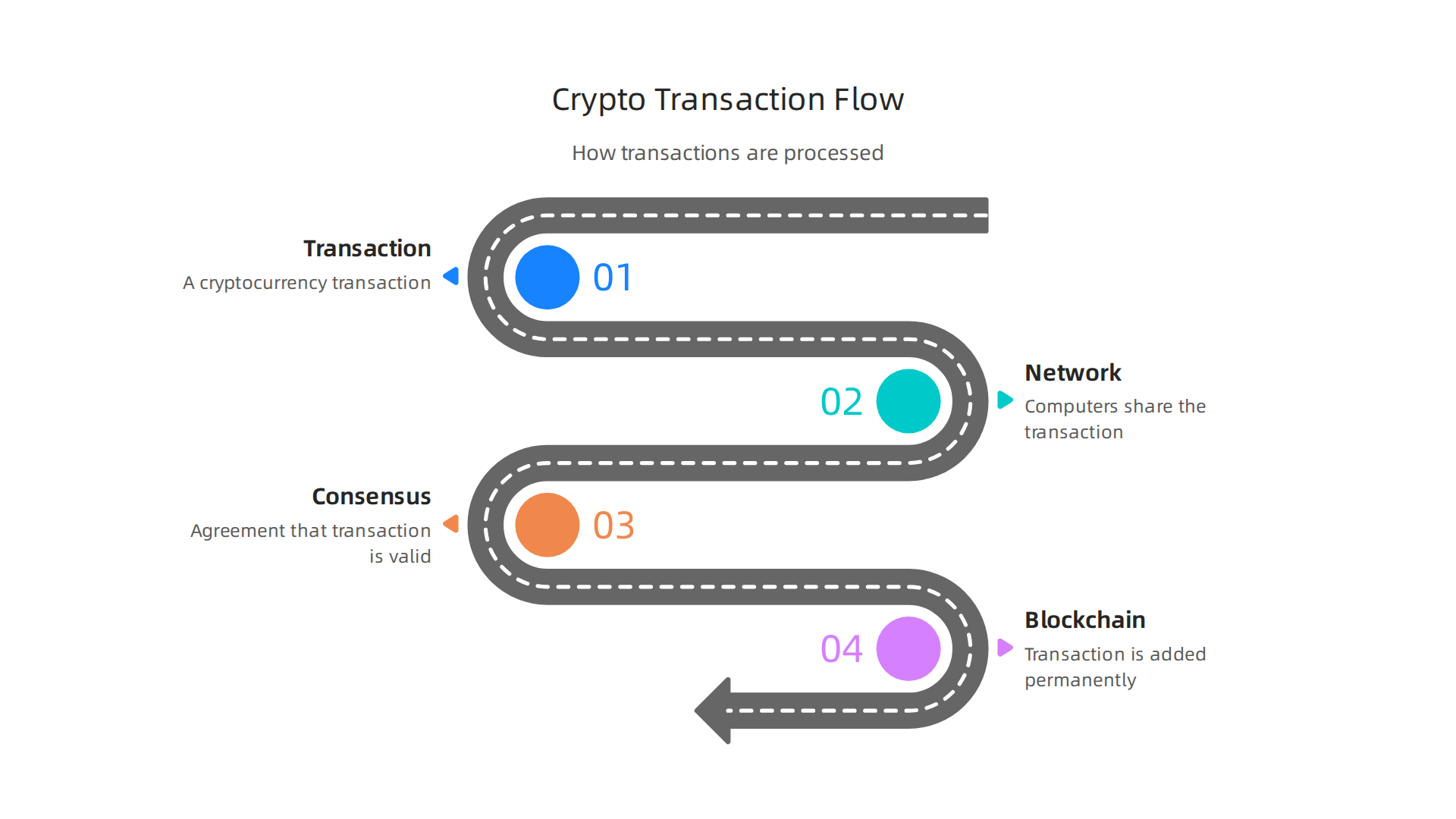
It’s a fancy word for saying "everyone agrees on the rules."
Here’s how it works:
- Sending Crypto: You tell the network you want to send crypto.
- Checking and Verifying: The computers in the network check to make sure you have enough crypto and that your request is valid. They race to solve a complex puzzle, which helps secure the transaction [5].
- Adding to the Chain: Once a computer solves the puzzle and other computers agree it’s correct, your transaction, along with others, gets put into a new "block" (train car). This new block is then added to the end of the blockchain.
- Permanent Record: Once your transaction is on the blockchain, it’s there forever. This makes the system very trustworthy and transparent for everyone [6].
This whole system helps explain the deep "crypto meaning" of security and trust without a middleman. It’s how cryptocurrencies like Bitcoin operate, building a robust digital economy. Knowing this also helps you understand the advantages and disadvantages of Bitcoin and cryptocurrencies in 2026.
Some cryptocurrencies also let you "stake" your crypto, which means you lock it up to help secure the network and earn rewards. This is another way these networks achieve consensus, known as "Proof of Stake," and can be a good path to explore when thinking about which crypto to invest in 2026.
Understanding these basic parts of how crypto works is a big step. It helps us see why so many people are turning their lives around with crypto by learning how to manage their money in new ways. If you want to keep learning about this exciting digital world in simple, easy steps, the free Clicks and Trades newsletter can help. It offers clear guidance and safety tips, helping you avoid common mistakes and navigate the digital finance world with more confidence.
Ready to make more sense of crypto and stablecoins?
Types of cryptocurrencies: coins, tokens, and where stablecoins fit
We just learned how the blockchain makes cryptocurrencies work, like a super-secure digital record. But here’s the thing: not all cryptocurrencies are the same. Just like how not all money in the real world is the same (think dollars versus stocks), digital money comes in different types too. Understanding this gives us an even clearer picture of the "crypto meaning" in today’s digital world.
Let’s look at the main kinds:
Native Coins
These are the original digital money of a blockchain. They are built directly into their own special network.
- Bitcoin (BTC) is the most famous example. It runs on its own Bitcoin blockchain. You use Bitcoin to send money and to pay for how the network works.
- Ether (ETH) is another big one. It’s the native coin for the Ethereum blockchain. People use Ether to pay for transactions and special programs on Ethereum.
These coins are often what people first think of when they hear about crypto. They are like the main currency of their own digital country.
Utility Tokens
Think of utility tokens as special passes or coupons for a specific digital service or platform.
- You might use a utility token to access a feature, pay for a service, or even vote on decisions within a certain app or game built on a blockchain.
- They get their value from being useful inside that specific ecosystem.
Security Tokens
These are different because they represent ownership in real-world things.
- Imagine a token that says you own a piece of a company, a part of a building, or even some art. That’s a security token.
- They are like digital versions of traditional stocks or bonds. Because they represent real assets, they usually follow special rules from governments, like the rules for buying and selling stocks.
Stablecoins: The Calm in the Storm
Now, let’s talk about a very important type of cryptocurrency called stablecoins. The native coins like Bitcoin can go up and down in value very quickly. This is often called volatility. While some people are turning their life around with crypto through investing, the big swings can be tricky for everyday use. Stablecoins were created to solve this problem by keeping their value steady [7]. They aim to give you the benefits of crypto, but without the wild price changes.
So, how do stablecoins stay stable?
- Peg Mechanics: Stablecoins try to keep their price "pegged" or tied to a stable asset, like the US dollar. This means one stablecoin should almost always be worth one US dollar [1].
- Backing Assets: To keep this peg, most stablecoins are backed by real-world assets. This usually means they hold a reserve of actual US dollars, government bonds, or other safe investments [8]. This reserve acts like a promise that your stablecoin can be traded for that real-world value. Some stablecoins are even backed by gold or other goods [5].
- Counterparty Risk: Because stablecoins rely on these reserves, you have to trust the company or group that holds those reserves. This is called "counterparty risk." You need to know that they actually have the money they say they do and that they will always let you exchange your stablecoin for the backing asset [6]. In 2026, regulators are paying close attention to how stablecoins are managed to help protect users [3].
Understanding stablecoins is key for anyone looking to use crypto for more stable cash management or payments. It helps to inspect these digital assets carefully. If you want to dive deeper into how to check stablecoins and understand their risks and different types, we have a whole guide to help you make smart choices for your digital money https://inspectstablecoins.com/stablecoin-due-diligence-the-essential-guide-to-risks-and-types. It’s all about making sure you know what you’re getting into, which also helps when you consider the advantages and disadvantages of Bitcoin and cryptocurrencies.
Learning about these different types of crypto helps you see the bigger picture of digital finance. To keep learning more about crypto and stablecoins in simple, easy steps, the free Clicks and Trades newsletter can help. It offers clear guidance and safety tips, helping you avoid common mistakes and navigate the digital finance world with more confidence.
Ready to make more sense of crypto and stablecoins?
Stablecoins explained: fiat-backed, crypto-collateralized, algorithmic — how pegs are maintained
We’ve talked about how stablecoins aim to keep their value steady, making them less rocky than coins like Bitcoin. But how do they actually do this? Well, there are a few main ways stablecoins are built to stay "pegged" to something stable, like the US dollar. Understanding these different kinds helps you get an even better idea of the true "crypto meaning" for everyday money use.
Let’s break down the main types:
1. Fiat-Backed Stablecoins
These are the most common type. They try to hold their value by being backed by real money, like US dollars, or other safe things like government bonds. Think of it like this: for every stablecoin in circulation, the company that made it holds one dollar (or dollar equivalent) in a bank account or in secure investments [8].
- How the peg is maintained: The company promises you can always trade your stablecoin for the same amount of real money it’s pegged to, usually 1:1 with the US dollar [1]. This promise is only as good as the company’s reserves. That’s why in 2026, many stablecoin issuers share monthly reports or "attestations" to show they really have the reserves they claim [9, 11]. These reports help you trust that the coin is truly backed.
- Failure mode: If the company doesn’t actually have enough reserves, or if they invest those reserves in risky things that lose value, the stablecoin might lose its peg and become worth less than expected [7].
2. Crypto-Collateralized Stablecoins
These stablecoins get their stability from other cryptocurrencies. But because cryptocurrencies like Bitcoin can go up and down in value a lot, these stablecoins need extra protection.
- How the peg is maintained: Instead of being backed 1:1, they are "over-collateralized." This means that for every dollar’s worth of stablecoin, there might be $1.50 or $2.00 worth of other crypto held as backup [2]. This extra cushion helps absorb price drops in the backing crypto. If the value of the backing crypto drops a little, there’s still enough to cover the stablecoin’s value. These systems often use smart contracts to automatically manage the collateral.
- Failure mode: Even with over-collateralization, a very sudden and large drop in the value of the backing crypto could still cause the stablecoin to lose its peg. This makes them a bit riskier than fiat-backed ones, as evidence suggests that fiat-backed stablecoins generally maintain stronger pegs [4].
3. Algorithmic Stablecoins
These are quite different. They don’t rely on real-world money or even other cryptocurrencies as direct backing. Instead, they use computer programs and economic rules to keep their value stable [5].
- How the peg is maintained: These systems work by changing the supply of the stablecoin based on demand. If the price goes above $1, the algorithm might create more stablecoins to bring the price down. If the price goes below $1, it might try to take stablecoins out of circulation to make them more valuable. This is often done by linking the stablecoin to another crypto asset in the same system, sometimes called a "seigniorage" model [2].
- Failure mode: This method is the most complex and has proven to be the most fragile. If there’s a big rush to sell the stablecoin, the algorithm might not be able to react fast enough, causing it to lose its peg badly [4]. These models are less common in 2026 due to past challenges.
Hybrid Models
Some stablecoins mix and match these ideas. They might use a bit of fiat backing and some crypto collateral, trying to get the best of both worlds. The goal, no matter the type, is always to minimize price swings and keep that stable "peg" as steady as possible [1].
Learning about these different types is key to understanding the full "crypto meaning" and making smart choices. If you’re looking to manage your digital cash or are interested in the advantages and disadvantages of Bitcoin and cryptocurrencies, knowing how stablecoins work is a big part of turning your life around with crypto safely. You can dive much deeper into inspecting stablecoins and understanding their specific risks and designs with our detailed guide on stablecoin due diligence.
Want to keep learning about crypto and stablecoins in simple, easy steps? The free Clicks and Trades newsletter offers clear guidance and safety tips, helping you avoid common mistakes and navigate the digital finance world with more confidence.
Ready to make more sense of crypto and stablecoins?
Assessing Trust: Audits, Reserves, Transparency, and Regulatory Signals
We’ve learned about the different kinds of stablecoins and how they try to stay steady. But here’s the big question: How can you truly know if a stablecoin is safe and if its promises are real? This is where looking at their reports, reserves, and how open they are becomes super important. It helps us understand the real "crypto meaning" of trust.
In 2026, there are key things we check to see if a stablecoin is trustworthy.
Attestations Versus Audits: What to Look For
When you look at a stablecoin, you’ll often hear about "attestations" and "audits." While they both sound like checks, they are a bit different.
- Attestations (Proof of Reserves): Think of an attestation as a snapshot. An independent accounting firm checks on a specific date to make sure that the number of stablecoins out in the world matches the reserves the company claims to have [1]. These reports, often called "Proof of Reserves," mostly focus on just two things: the tokens issued and the assets backing them [2]. Many stablecoin makers now share these reports every month to show they are keeping their promises [3], [4].
You can often find these monthly reports on the issuer’s website, like Paxos does for their USDG stablecoin [5].
- Audits: An audit is a much deeper dive. It looks at the whole financial health of the stablecoin company. This includes reviewing all their financial records, checking how they manage money, and making sure their statements are accurate [6]. Audits also check for risks like bugs or security holes in the computer code that runs the stablecoin [7]. While attestations confirm specific reserve numbers, audits give a broader picture of the company’s financial practices and systems [8]. Some stablecoins, like USDC, have annual audits to show their overall reliability [9].

Both attestations and audits help build trust by showing that someone independent has checked the stablecoin’s claims. However, it’s important to know that even with these checks, there’s always a small amount of risk involved [10]. They reduce risk but don’t take it away completely.
Watching for Regulatory Signals and Red Flags
Beyond reports, what else tells us if a stablecoin is trustworthy?
- Regulatory Notices: Look for stablecoins that follow rules. In 2026, governments around the world are getting more involved in crypto. Stablecoins that are properly licensed and follow rules for how they manage their reserves and handle your money are generally safer [11]. This also includes having good plans for getting your money back if needed and clear governance rules [12]. Knowing that a stablecoin operates under clear rules can make a big difference in reducing risks when you’re thinking about turning your life around with crypto.
- Custody Practices: How does the company hold onto its reserves? Do they use secure banks or trusted partners to keep the backing assets safe? Good stablecoins will be clear about this.
- Red Flags: Watch out for anything that seems unclear. If a stablecoin doesn’t regularly share its reserve reports, or if their reports are hard to understand, that’s a warning sign [13]. Also, be careful if a stablecoin’s backing assets aren’t clearly stated or seem too risky. A lack of clear rules or independent checks can suggest higher risk for your digital money [14].
Understanding these details is part of doing your "due diligence" on stablecoins. It helps you make smart choices, especially when thinking about the advantages and disadvantages of Bitcoin and cryptocurrencies, and how stablecoins fit in. For a deeper look at how to check a stablecoin’s safety, you can explore our guide on stablecoin due diligence.
If you want more simple, step-by-step guidance on how to navigate the world of crypto and stablecoins safely, the free Clicks and Trades newsletter is a great resource. It offers clear advice and tips to help you avoid common mistakes and gain confidence.
Ready to understand crypto and stablecoins better?
Now, that we understand how to check if a stablecoin is trustworthy, let’s look at why people actually use them. Stablecoins are not just for big investors; they have many helpful everyday uses for regular people and small businesses in 2026. They offer a stable way to step into the world of crypto.
Here are some common ways stablecoins are being used today:
Payments
One big reason people like stablecoins is for payments. Imagine sending money almost instantly and cheaply to anyone, anywhere in the world. That’s the main idea.
- For Individuals: You can use stablecoins to pay for things online or send money to friends and family. It’s often faster and cheaper than traditional bank transfers, especially for international payments. This gives a whole new "crypto meaning" to sending money.
- For Small Businesses (SMBs): Small businesses might use stablecoins to pay suppliers, especially if those suppliers are in other countries [11].

It can cut down on bank fees and speed up how quickly payments go through. This is an advantage of bitcoin and cryptocurrencies in general, but stablecoins add the benefit of steady value.
Pros: Fast payments, lower fees for international transfers, easy access to digital money [13].
Cons: Not all stores or people accept stablecoins yet, and you still need a way to change them to regular money if needed.
Remittances (Sending Money Across Borders)
Sending money to family in another country is called a remittance. This is a huge use for stablecoins.
Think about someone working abroad who wants to send money home. Regular bank wires can be slow and expensive. Stablecoins make this process much easier and more affordable [12]. They can help people send money quickly, which could mean a lot for those trying to improve their financial situation and really start turning their life around with crypto.
Pros: Much faster and cheaper than traditional services for sending money internationally [12].
Cons: The person receiving the money needs to know how to get and use stablecoins, or how to change them into their local currency.
Treasury Management for Small Businesses
Small businesses often keep extra money, called treasury, to pay for things or save for the future. Stablecoins are becoming a smart option for this.
Instead of just holding regular cash in a bank, businesses can hold stablecoins. This allows them to quickly move money into other cryptocurrencies if they want to, or even earn some interest in certain crypto platforms. While we won’t dive into "what is crypto staking" right now, holding stablecoins in some platforms can offer similar small gains compared to traditional bank accounts. This strategy helps them manage their money digitally and be ready for the future of finance [14].
Pros: Can earn some interest, quick access to crypto markets, a way to hold money that’s safe from the ups and downs of other cryptocurrencies like Bitcoin [15].
Cons: Requires new accounting practices and understanding the risks of the chosen stablecoin.
What to Think About When Using Stablecoins
No matter how you plan to use stablecoins, there are a few important things to keep in mind:
- Getting In and Out (On/Off-Ramps): This means how easily you can change your regular money into stablecoins, and stablecoins back into regular money. You need platforms that make this smooth and easy.
- Where You Keep Your Money (Custody Choices): You can keep stablecoins yourself using a digital wallet, or you can leave them on a crypto exchange. Each choice has its own set of rules and risks. If you’re using an exchange, it’s good to learn how to avoid common mistakes when choosing the best crypto trading platform in 2026.
- How Fast and How Much (Settlement Speed and Fees): Stablecoin transactions are usually very fast, often taking just seconds or minutes. Fees are usually low, especially compared to bank wire transfers [13].
- Money Rules (Accounting and Tax Implications): For businesses, using stablecoins means you need to keep good records for accounting and taxes. It’s a new area, so staying organized is key. The U.S. Treasury Department is even working on rules for payment stablecoins [15].
Understanding these practical uses and their ins and outs can help you see the full picture of stablecoins. They offer many advantages of bitcoin and cryptocurrencies but with the stability of regular money, making them a useful tool for everyday finance.
If you want more clear, step-by-step help to understand crypto and stablecoins for payments, treasury, or remittances, the free Clicks and Trades newsletter offers great advice. It’s designed to help you make smart choices and feel more confident.
Ready to make your crypto experience easier and more secure?
You’ve learned how stablecoins can make payments easier, help with sending money across borders, and even manage business funds. But how do you know if a stablecoin is really safe and dependable? The true "crypto meaning" of trust comes from doing your homework.
Here’s a simple checklist to help you evaluate stablecoins, along with ways to lower your risks in 2026.

Your Stablecoin Due Diligence Checklist
When you’re looking at a stablecoin, ask yourself these questions:
- Who is in Charge? (Legal Entity)
- Is there a clear company or group behind the stablecoin? You want to know who is responsible for it. Regulators are really focused on this now, pushing for more clarity in 2026 [3].
- Do they have the right licenses to operate where you live? Knowing this helps you understand their standing.
- What Backs the Stablecoin? (Reserves)
- What kind of money or assets are they holding to match the stablecoins they’ve put out? Most trustworthy stablecoins are backed by real money like US dollars or safe government bonds [4].
- Are their reserves truly "full" or "overcollateralized," meaning they have at least as much or more backing assets than stablecoins in circulation [24]?
- Where are these reserves held? Ideally, they should be kept in safe, regulated banks or institutions [2].
- How Often Are Reserves Checked? (Audit Cadence)
- Do independent auditors regularly check their reserves to make sure the stablecoin is truly backed 1-to-1? This is super important for trust [24].
- How often do these audits happen? More frequent checks, like monthly or quarterly, are better than yearly ones. You should be able to see these reports easily [25].
- Can You Get Your Money Out? (Redemption Mechanisms)
- How easy is it to change your stablecoins back into regular money? This is called "redemption."
- Are the steps clear? Are there any hidden fees or long waiting times?
- How Safe Are Their Systems? (Operational Controls)
- What steps does the stablecoin issuer take to keep their systems safe from hackers or mistakes?
- Do they have regular security checks and strong controls in place [26]?
By checking these points, you can feel more confident about the stablecoins you choose.

It’s about making sure your digital money is as solid as the money in your bank account.
A Simple Risk Mitigation Framework
Even with a good checklist, it’s smart to have a plan to protect your money. Here’s a basic playbook for individuals and small businesses:
- Don’t Put All Your Eggs in One Basket (Diversification)
- Instead of keeping all your funds in one stablecoin, spread it across a few different, well-vetted ones. This way, if one has a problem, your whole investment isn’t at risk.
- Test the Waters (Withdrawal Testing)
- Before you put a lot of money into a stablecoin, try converting a small amount of regular money into stablecoins and then converting it back. See how smooth the process is. This helps you understand the "on/off-ramps."
- Set Limits (Investment Limits)
- Only put money into stablecoins that you can afford to lose. While stablecoins are designed to be stable, no investment is 100% risk-free.
- Keep an Eye Out (Monitoring)
- Stay informed. Watch the news for any updates or concerns about the stablecoins you use. Look for new audit reports. Being aware is a big part of turning your life around with crypto in a smart way. For more specific guidance on stablecoin risks, you might find our guide on stablecoin due diligence helpful.
By using this checklist and following these simple risk tips, you’ll be much better prepared to use stablecoins wisely. They offer some great advantages of bitcoin and cryptocurrencies without the wild price swings, making them a useful tool for everyday finances.
Want clear, step-by-step help to understand crypto and stablecoins for payments, treasury, or remittances? The free Clicks and Trades newsletter offers great advice.

It’s designed to help you make smart choices and feel more confident.
Ready to make your crypto experience easier and more secure?
Summary
This article explains the real meaning of "crypto" in clear, nontechnical language and focuses on stablecoins — the cryptocurrencies designed to hold a steady value. It covers core concepts like decentralization, blockchains, consensus, and the difference between native coins and tokens so you can tell what each asset is for. The guide then walks through how stablecoins maintain their peg (fiat-backed, crypto-collateralized, algorithmic, and hybrid models), how to assess reserves, audits versus attestations, and regulatory signals that affect safety. You’ll learn practical use cases — fast payments, remittances, and treasury management for small businesses — plus the key risks and operational trade-offs. The article finishes with a clear due-diligence checklist and simple risk-mitigation steps (diversify, test withdrawals, set limits, monitor). After reading, you’ll know how to evaluate stablecoins, spot red flags, and make safer choices when using or holding digital cash.