
BTC Volatility and Stablecoin Trust: What 2026 Investors Must Know

Introduction: Navigating BTC Volatility and Stablecoin Trust
Checking the BTC price today can feel like a rollercoaster ride. One day, the Bitcoin price USD live chart is soaring. The next, it’s taking a steep dive.

This wild swing is the reality of crypto. Experts are always trying to forecast where it goes next. For 2026, some analysts predict a price around $76,705, while others see a chance it could climb toward $90,000.
That kind of volatility makes planning tough. You might wonder if you should check the Bitcoin chart live one more time before making a move.
So, where do you turn for stability? Many people look to stablecoins. Their value is designed to stay steady, often pegged to a dollar. This sounds perfect. You get the benefits of crypto, without watching your savings bounce up and down with every Dogecoin price or Cardano price swing.
But here’s the thing. That stability isn’t magic. It’s built on trust. You need to trust that the company or protocol behind the stablecoin actually holds the reserves they claim. Without understanding that, you’re just trading one type of risk for another.
That’s where this guide comes in. We’ll cut through the noise. You’ll get clear, reliable insights into what drives the BTC price and, more importantly, how to find truly stable stable coins. We’ll help you move from hoping for the best to making informed decisions.
If you’re starting out and feel overwhelmed, you’re not alone. Getting trustworthy, step-by-step guidance is key. For a simple path forward, consider resources like the free Clicks and Trades newsletter. It breaks down crypto concepts into easy-to-understand lessons.
Ready to build confidence? Let’s start by learning how to properly evaluate stability. A great first step is reading our essential guide to stablecoin due diligence, which will give you the foundation you need.
Sign Up for clear, actionable crypto insights delivered to your inbox.
Understanding BTC Price: Volatility and Market Forces
So, what actually makes the BTC price move? It’s not random. The price you see on a Bitcoin chart live is a real-time reflection of a few powerful forces. Understanding them is your first step to navigating the market with more confidence, and less anxiety.
Here are the key drivers that push and pull the Bitcoin price USD live every day.
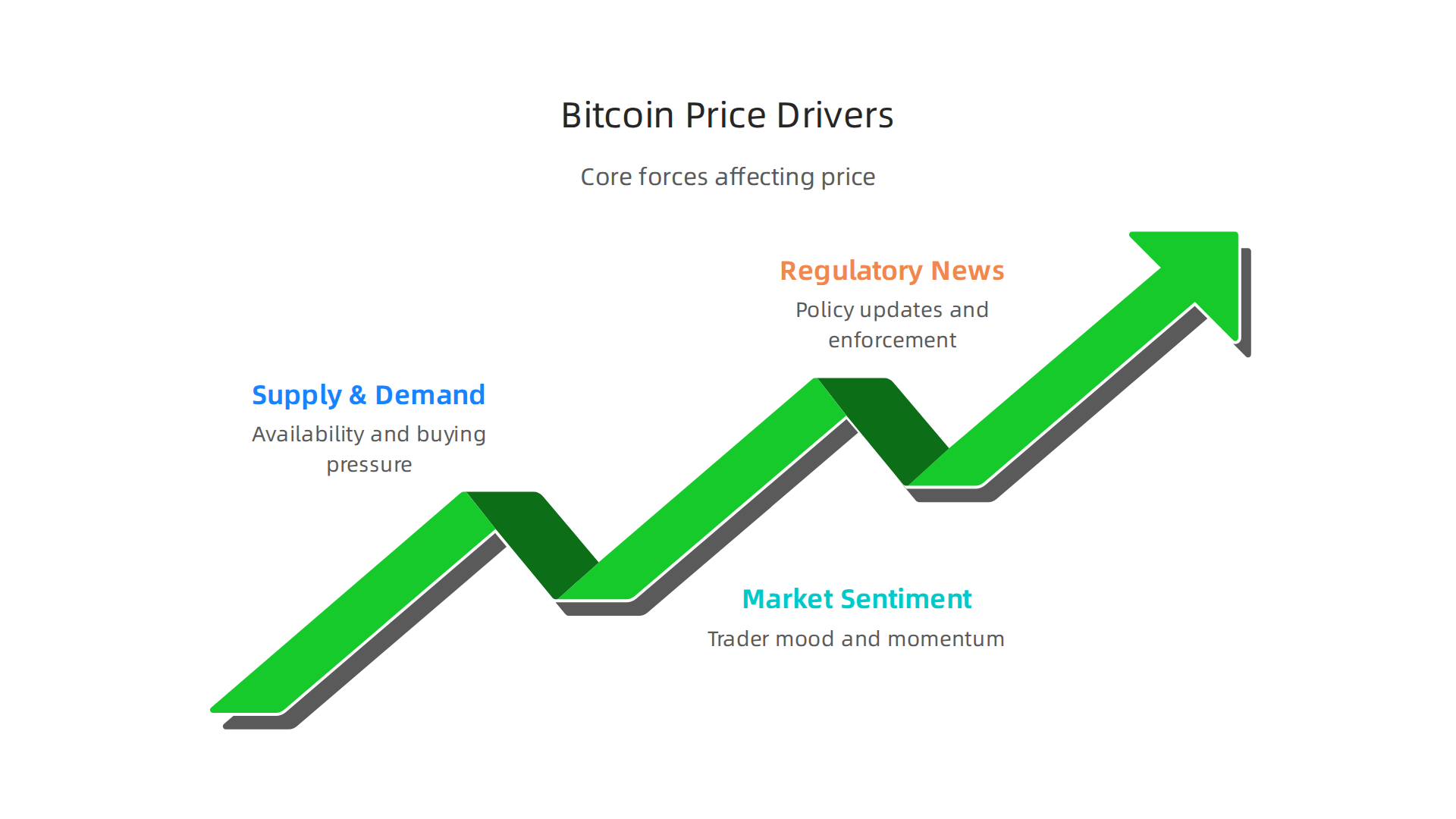
1. Supply and Demand: The Core Engine
This is the most basic rule. Bitcoin has a fixed maximum supply of 21 million coins. New coins are created through mining, but the rate is cut in half every four years in an event called "the halving." This predictable scarcity is built into the system. When more people want to buy Bitcoin than sell it, the BTC price today goes up. When selling pressure increases, the price falls. Simple in theory, but the "why" behind that buying and selling is complex.
2. Market Sentiment: The Mood of the Crowd
Fear and greed are powerful market movers. Sentiment is shaped by:
- Media headlines: Big news stories can trigger rapid buying or selling.
- Social media trends: Hype around tokens like Dogecoin price or Cardano price can influence the broader crypto mood.
- Institutional adoption: News of a major company or country buying Bitcoin can boost confidence and prices.
- Macroeconomic factors: In 2026, investors still watch interest rates and inflation, as these affect how people view all risky assets, including crypto.
3. Regulatory News: The Rulebook Changes
Government announcements about crypto regulation can cause immediate volatility. News about potential bans, new laws, or supportive frameworks can send the BTC price soaring or plummeting in hours. This uncertainty is a constant feature of the crypto landscape.
A Glimpse at Historical Patterns
Looking back helps us see cycles. Bitcoin has historically experienced boom and bust cycles, often following its halving events. After past halvings, periods of increased prices have often followed. Analysis from 2025 noted that "post-halving supply is low, liquidity is rising," which are factors many watch in 2026 to gauge market direction. You can explore these long-term trends on a detailed Bitcoin price history chart.

Tools and Metrics for Analyzing BTC Price
You don’t need to guess. You can use data:
- Live Charts: Watch the BTC chart on trading platforms to see support and resistance levels.
- Trading Volume: High volume can confirm a price trend is strong.
- Prediction Platforms: Some analysts look to prediction markets. For example, one leading platform currently assigns a high probability to Bitcoin reaching $90,000 before 2027. Other price predictions for 2026 use different models, showing a range of possible outcomes and highlighting the inherent uncertainty.
This constant motion is exactly why people seek stability elsewhere. Once you understand the forces behind the BTC price, the value of a truly reliable stablecoin price becomes crystal clear. The next step is learning how to find those stable havens. A solid foundation is essential, which is why we recommend reading our essential guide to stablecoin due diligence.
Staying informed in a moving market is key. For clear, step-by-step breakdowns of these concepts without the hype, consider joining the free Clicks and Trades newsletter. It’s designed to help you build knowledge steadily.
Sign Up for straightforward crypto insights delivered to your inbox.
The Role of Stablecoins in a Volatile Crypto Market
After seeing the BTC price swing and learning what drives it, a natural question pops up. What if you need to use crypto but can’t handle that level of risk? This is where stablecoins step in.
A stablecoin is a type of cryptocurrency designed to have a stable value. It’s "pegged" to something else, most often a government-issued currency like the US dollar. While you watch the bitcoin price USD live or check an ETH price chart, a stablecoin’s value aims to stay steady at $1.00. This stability makes them a safe harbor in the stormy crypto seas.
Think of them as digital cash for the blockchain world.
How Do Stablecoins Stay Stable?
Maintaining that $1 peg is the core challenge. According to industry experts, stablecoins use two main approaches to keep their value: holding asset-backed reserves or using algorithmic controls.
- The Reserve Method: For every digital stablecoin in circulation, the issuing company holds a reserve of real-world assets. This is like having cash in a vault backing up the digital tokens. A 2026 overview notes that a fiat-backed stablecoin is pegged to a currency, like the US Dollar, when that currency is held in reserve.
- The Algorithmic Method: These stablecoins have no traditional reserves. Instead, as one academy explains, a smart algorithm automatically manages the circulating supply of the stablecoin to maintain the peg. If the price goes above $1, the system creates more coins to push the price down. If it falls below, it reduces supply to push the price back up.
Understanding how a stablecoin maintains its peg is crucial for assessing its safety.
The Three Main Types of Stablecoins
Not all stablecoins are built the same. Knowing the types helps you understand the trade-offs between stability, transparency, and risk.
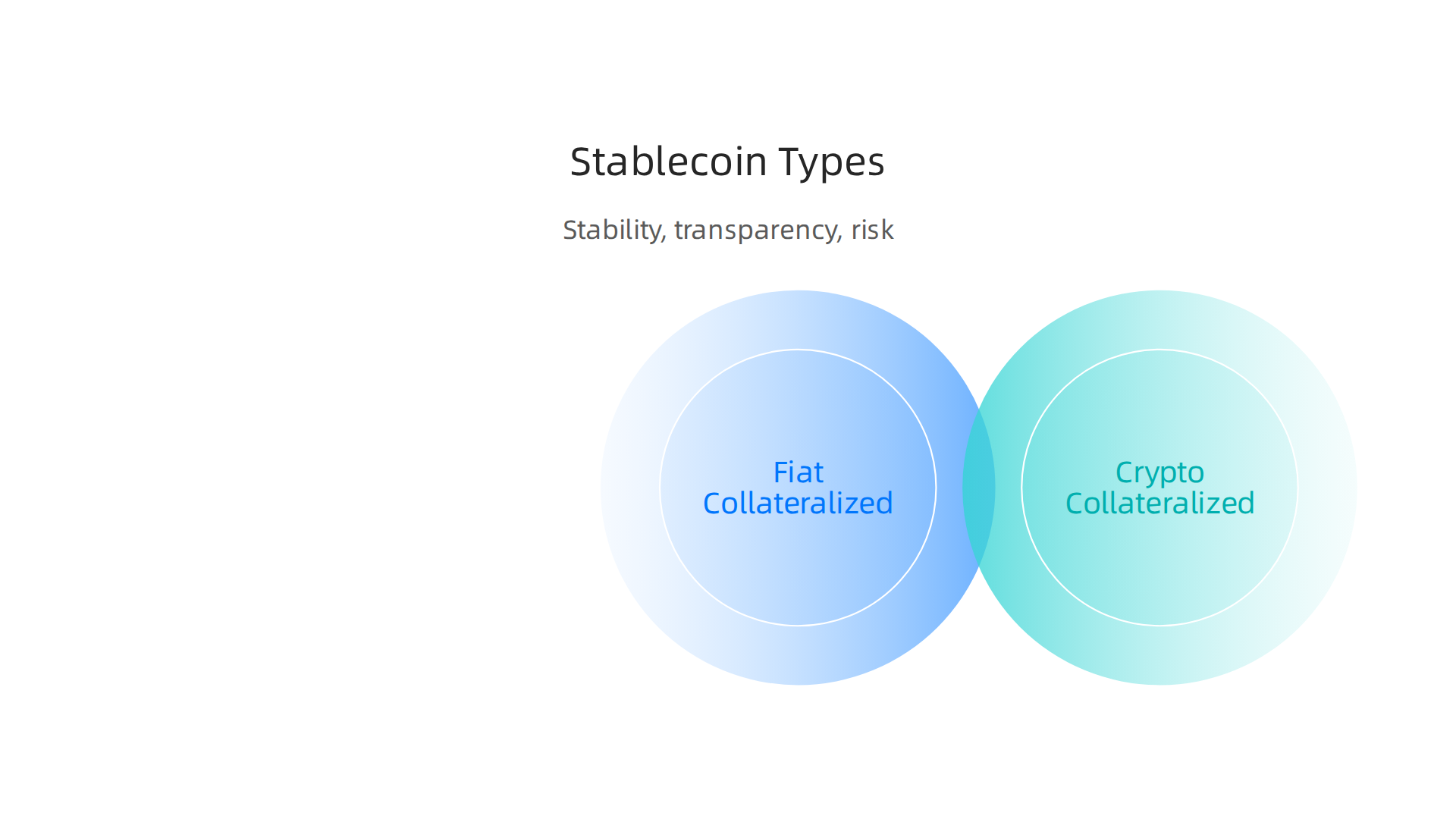
- Fiat-Collateralized Stablecoins: These are the most common. They hold reserves of a fiat currency, like US dollars, in a bank account. For every digital token, there’s (theoretically) one real dollar held. They aim for simplicity and direct stability.
- Crypto-Collateralized Stablecoins: These are backed by other cryptocurrencies, like Ethereum. Because crypto is volatile, these stablecoins are often "over-collateralized." This means they hold $1.50 or $2.00 in crypto reserves for every $1 stablecoin issued, to absorb price swings in the backing assets.
- Algorithmic Stablecoins: As mentioned, these use no physical reserves. They rely solely on code and market incentives to control supply and demand. This model can be innovative but has historically carried higher risk if the algorithm fails under extreme market stress.
Choosing between them depends on your need for decentralization versus your comfort with different risk models.
Why Would You Use a Stablecoin?
For individuals and small businesses, stablecoins solve real problems that volatile coins like Bitcoin or Ethereum can’t.
- A Safe Trading Pair: Instead of cashing out to your bank account every time, you can move profits into a stablecoin. It lets you stay in the crypto ecosystem, protected from a sudden drop in BTC price today, while you decide on your next move.
- Send Money Fast and Cheap: Sending stablecoins across borders can be much faster and cheaper than traditional wire transfers, especially for small businesses.
- Earn Interest: Many platforms allow you to lend your stablecoins to earn a yield, often higher than a traditional savings account.
- Pay for Goods and Services: Some merchants accept stablecoins for payments, providing a stable digital currency for transactions without worrying about the XRP price live or Cardano price changing before the payment clears.
For anyone managing crypto investments, understanding stablecoins is as important as watching the Bitcoin chart live. They are the foundational tool for managing risk and executing strategies without constantly exiting to traditional cash.
Want to learn how to tell a truly reliable stablecoin from a risky one? Our essential guide to stablecoin due diligence breaks down the key questions to ask about reserves, transparency, and history.
Building knowledge in this space doesn’t have to be overwhelming. For clear, step-by-step guidance on using tools like stablecoins safely, consider joining the free Clicks and Trades newsletter. It’s designed to help you navigate the market with more confidence.
Sign Up for straightforward crypto insights delivered to your inbox.
How BTC Price Movements Impact Stablecoin Pegs
You’re watching the bitcoin chart live. The BTC price today is dropping fast. What do most traders do? They rush for the exit. But in the crypto world, the nearest exit is often a stablecoin.
This creates a direct link. When the BTC price falls sharply, demand for stablecoins usually spikes. People sell their volatile Bitcoin, Ethereum, or Cardano price holdings and move into the safety of a dollar-pegged token. This isn’t just a theory. It’s a proven market behavior during big swings.
This surge in demand is the first major test for a stablecoin’s peg. Can it handle everyone trying to get in at once?
When Crashes Tested the Peg
History shows us what happens under extreme pressure. Major market crashes have been the ultimate stress test for stablecoin mechanisms.
- The FTX Collapse (2022): When the FTX exchange imploded, it triggered a massive crypto sell-off. The panic caused several stablecoins to briefly lose their $1 peg as people questioned the safety of reserves. A Moody’s analysis notes that events like the FTX crash have driven multiple stablecoin depegs.
- The USDC Depeg (2023): This was a classic example of traditional finance stress spilling into crypto. When Silicon Valley Bank failed, it was revealed that part of USDC’s reserves were held there. This caused a crisis of confidence. As a Federal Reserve report details, it led to a surge in redemption requests, and USDC lost its dollar peg for several days.
- Algorithmic Failures: The most famous case was Terra’s UST in 2022. Its complex algorithm, designed to maintain the peg, failed catastrophically during a market downturn. This event, as covered in a review of stablecoin depegging history, is a key lesson in the risks of designs that aren’t backed by real, liquid assets.
These events prove that a stable stablecoin price cannot be taken for granted when the wider market panics.
The Safety Mechanisms That Kick In
So, how do the good stablecoins survive these storms? They rely on the built-in protections we discussed earlier.
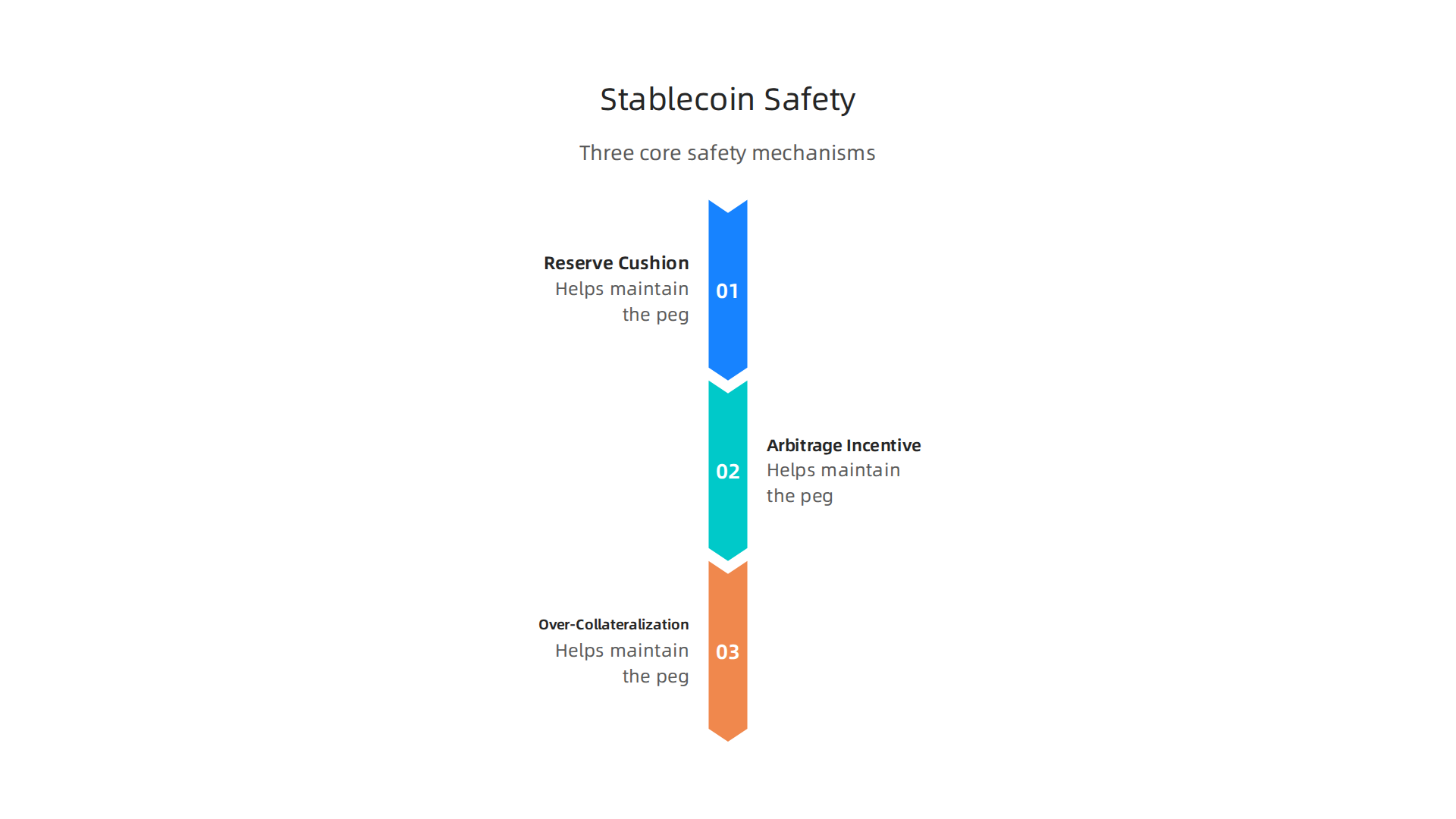
- The Reserve Cushion: For fiat-backed stablecoins, the key is having enough cash in the bank. When you swap your Bitcoin for a stablecoin, the issuer should have a real dollar to back that new token. If they don’t, the peg can break. Transparent and audited reserves are the best defense, a point emphasized in guides on how stablecoins maintain their peg.
- The Arbitrage Incentive: This is a crucial self-correcting mechanism. If a stablecoin like USDC trades at $0.98 because people are scared, professional traders jump in. They buy the cheap USDC, redeem it with the issuer for $1.00, and pocket the profit. This buying pressure pushes the price back to $1. This arbitrage is vital for stability, as studies on stablecoin runs explain.
- Over-Collateralization for Crypto-Backed Coins: Stablecoins backed by other cryptocurrencies plan for volatility. They are over-collateralized. So even if the Ethereum price USD in their reserves drops 30%, the stablecoin can still be worth $1 because they started with a big buffer.
Understanding these mechanics helps you see which stablecoins are built for a storm. It’s not just about watching the BTC chart or the XRP price live. It’s about knowing what’s happening under the hood of your safe haven.
Building this knowledge is your best strategy for navigating volatile markets. For a structured approach to evaluating all your crypto choices, including stablecoins, our simple 5 pillar method for investment decisions can help.
Want to stay updated on how market moves affect different coins and get practical safety tips? The free Clicks and Trades newsletter breaks it down in plain language, helping you make more confident decisions.
Sign Up for clear, actionable crypto insights delivered directly to you.
Key Factors to Watch in BTC Price Charts for 2026
So you understand how the BTC price today can trigger a rush into stablecoins. The next step is getting better at reading the bitcoin chart live itself. Knowing what to look for helps you anticipate moves, manage risk, and make smarter decisions, whether you’re watching Bitcoin price USD live or tracking Ethereum price USD.
Here are the key factors to focus on for your 2026 analysis.
Technical Indicators: The Chart’s Language
You don’t need to be a professional trader to understand the basics. These tools help you see patterns in the BTC chart.
- Support and Resistance: Think of these as price floors and ceilings. Support is a price level where buying tends to start, stopping a drop. Resistance is where selling often begins, stopping a rise. In 2026, watching where Bitcoin finds support can show you where confidence returns.
- Moving Averages: These lines smooth out price action to show the trend. The 50-day and 200-day averages are the most common. When the BTC price is above its moving averages, the trend is generally up. A crossover where the short-term average drops below the long-term one can signal a potential trend change.
- Relative Strength Index (RSI): This measures whether Bitcoin is overbought (RSI above 70) or oversold (RSI below 30). An oversold reading during a dip might suggest a bounce is coming.
Fundamental Factors Specific to 2026
Charts tell you what is happening. Fundamentals help explain why. For 2026, these are the big themes.
- Post-Halving Dynamics: The 2024 Bitcoin halving is now in the rearview mirror. The key question for 2026 is how the reduced new supply interacts with demand. Analysts are watching to see if the classic post-halving bull cycle continues or if we see a different pattern, as some 2026 market outlooks discuss.
- Institutional Adoption & ETF Flows: The big story of the mid-2020s. Consistent inflows into Spot Bitcoin ETFs can create steady buying pressure. Watch for news about new funds or major investment firms adding Bitcoin to their balance sheets.
- Macroeconomic Climate: Bitcoin is increasingly sensitive to interest rates and liquidity. In 2026, watch central bank policies and inflation data. A shift toward lower rates could be a positive signal for the BTC price and other assets like the Cardano price or XRP price today.
- Regulatory Clarity (or Lack Thereof): Clear rules in major economies like the U.S. or E.U. can boost confidence. Uncertainty or restrictive proposals can cause market-wide fear. This affects all digital assets, from Monero price to stablecoin price.
How to Interpret Charts for Risk Assessment
Reading a chart isn’t about predicting the future. It’s about measuring risk.
- Volatility Clusters: Big price swings often happen together. If you see the BTC chart becoming very volatile, it often means the Dogecoin price and Dash crypto price will get choppy too. This is a signal to check your risk tolerance.
- Volume Confirmation: A price move with high trading volume is more significant than one with low volume. A surge in the BTC price on huge volume suggests strong conviction. A drop on low volume might just be noise.
- Divergences: Sometimes the price makes a new high, but an indicator like the RSI does not. This "divergence" can be an early warning sign that the upward momentum is weakening.
Putting this analysis into practice takes time. For a structured way to evaluate not just Bitcoin but all your potential investments, our simple 5 pillar method for investment decisions provides a clear framework.
The best way to learn is by following along with clear explanations. The free Clicks and Trades newsletter breaks down these chart patterns and fundamental shifts in plain language, helping you connect the dots between the Bitcoin price CAD, the ETH price chart, and your own portfolio safety.
Sign Up for clear, actionable crypto insights delivered directly to you.
Assessing Stablecoin Risks: Beyond the Peg
So you know a falling BTC price can send people rushing into stablecoins for safety. But what if the safe harbor itself has hidden problems? A stablecoin losing its peg, meaning its value drops below $1.00, can cause just as much panic. In 2026, smart investors look beyond the simple promise of "one dollar" to understand the real risks underneath.
Here are the key dangers and how to spot them.
The Hidden Risks You Need to Know
Stablecoins aren’t magic. They rely on systems that can fail. The main risks fall into three categories.
- Reserve Opacity: This is a fancy term for "we can’t see the money." A stablecoin should have real assets, like cash or bonds, backing every token. If the company won’t show frequent, detailed audits from trusted firms, you don’t know if the money is really there. History shows this is a major red flag.
- Counterparty Risk: This means depending on someone else who could fail. The reserves might be held in a bank that collapses, or invested with a partner that goes bankrupt. For example, a 2025 Federal Reserve analysis noted how troubles at a single bank triggered a surge in redemptions for a major stablecoin, causing it to briefly lose its peg.
- Regulatory Changes: The rules are still being written. In 2026, authorities worldwide are expanding their frameworks for anti-money laundering and sanctions compliance. A new law or enforcement action could suddenly restrict how a stablecoin operates or who can use it, impacting its value and usability.
A Simple Framework for Checking Stablecoin Health
You don’t need to be a forensic accountant. Use this simple checklist to evaluate any stablecoin, whether you’re checking a stablecoin price or deciding where to park your cash.
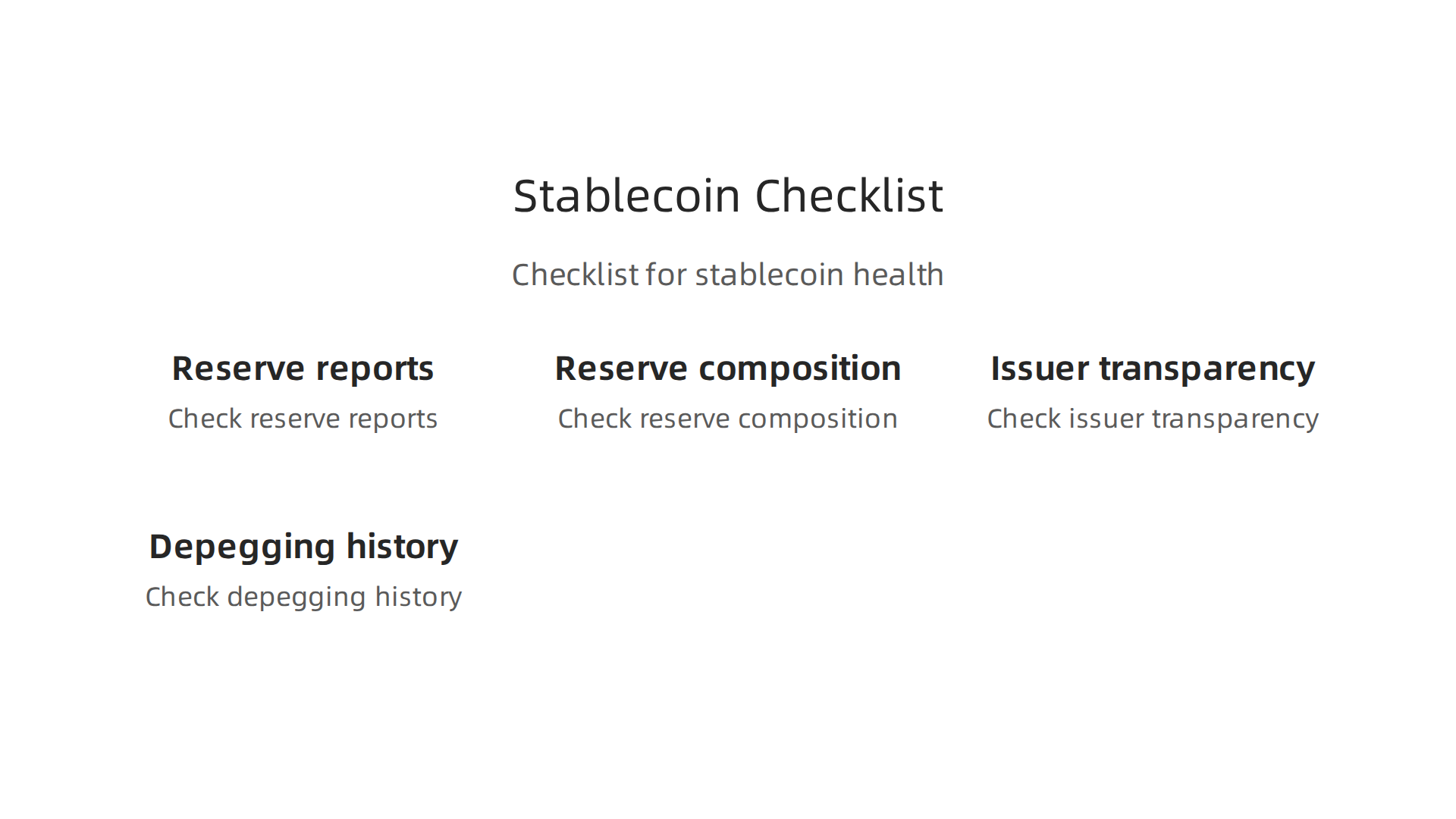
| What to Check | Why It Matters | Good Sign | Red Flag |
|---|---|---|---|
| Reserve Reports | Proves the assets exist. | Monthly or quarterly attestations from a top-tier audit firm (like a "Big Four" company). | No recent reports, or reports from an unknown auditor. |
| Reserve Composition | Shows how safe the backing assets are. | Mostly cash and very short-term U.S. Treasury bills. | Risky investments like corporate debt, loans, or other cryptocurrencies. |
| Issuer Transparency | Indicates trust and accountability. | Clear leadership team, physical address, and open communication about operations. | Anonymous team, no official contact information. |
| Depegging History | Reveals past stability under stress. | Has maintained its $1 peg through major market events. | A history of losing its peg during market volatility. |
For a deeper dive into this process, our essential guide to stablecoin due diligence walks you through each step.
Red Flags and Warning Signs
How do problems usually start? Watch for these warnings.
- The Stablecoin Price Wobbles: Even a small, sustained drop below $0.995 can be an early signal of market doubt. Check news and social sentiment immediately.
- Sudden Silence from the Issuer: If a normally communicative team goes quiet during market stress, it’s a bad sign.
- Concentrated Reserves: If most of the reserve assets are held in one bank or one type of risky asset, a single failure can threaten the whole system. As noted in a 2026 industry report, understanding these concentration risks is a key part of compliance and safety.
- Rumors of Banking Problems: Like the historical example with Silicon Valley Bank, rumors about the health of a bank holding stablecoin reserves can trigger a "run" as people rush to redeem their tokens.
Remember, when a stablecoin depegs, it doesn’t just hurt its own holders. It can create fear that spreads across the entire market, affecting everything from the Ethereum price USD to the XRP price live. The shockwaves can even influence the recovery path of the BTC price today.
Learning to spot these risks takes the mystery out of stablecoins and turns them into a tool you can use with confidence. For ongoing, plain-language analysis that helps you connect these dots, the free Clicks and Trades newsletter breaks down complex topics into actionable insights.
Sign Up for clear, actionable crypto insights delivered directly to you.
Best Practices for Monitoring Prices and Mitigating Risks
Knowing the risks is the first step. The next step is building a simple system to watch for them and protect yourself. In 2026, staying safe means staying informed and spreading out your risk. Here are three best practices you can start using today.
1. Use the Right Tools for Real-Time Monitoring
You don’t need to stare at screens all day. Set up smart tools that do the watching for you.
- Portfolio Trackers: Use apps or websites that let you see all your holdings in one place. You can set alerts for specific price levels. For example, you can get a notification if a stablecoin’s stablecoin price drops below $0.995 or if the btc price today makes a big move.
- On-Chain Analytics: Some tools let you see what’s happening on the blockchain itself. You can watch for large movements of funds out of a stablecoin’s reserve wallet or track overall market sentiment. A 2026 guide on the best crypto analytics tools highlights how these platforms help investors see beyond simple price charts.
- News Aggregators: Set up feeds for the stablecoins you use and their issuing companies. A sudden spike in negative news can be an early warning sign before a price drop appears.
Monitoring isn’t just about the bitcoin price USD live or ethereum price usd. It’s about understanding the connections. A falling btc price might mean people are moving into stablecoins, but trouble in a major stablecoin can cause fear that spills over into the entire market, affecting everything from the xrp price live to the cardano price.
2. Diversify Your Stablecoin Holdings
Never put all your eggs in one basket. This classic rule is your strongest defense.
If you hold a meaningful amount in stablecoins, split it across two or three different, well-audited options. Look for ones with different reserve structures (e.g., one that is fully backed by cash and Treasuries, another that uses a different, but still transparent, model). This way, if one stablecoin has an issue, your entire cash position isn’t at risk.
Diversification also applies to where you hold them. Don’t keep all your stablecoins on a single exchange. Use a combination of a reputable exchange and a personal hardware or software wallet you control. This protects you from exchange-specific problems.
3. Perform Regular Audit and Transparency Checks
Your due diligence isn’t a one-time task. Make it a regular habit, like checking your bank statement.
- Schedule Quarterly Reviews: Mark your calendar every three months to revisit the stablecoins you use. Go back to the issuer’s website. Have they published a new reserve attestation report from a top-tier audit firm? If their last report was six months ago, that’s a red flag. For a detailed walkthrough of what to look for, our essential guide to stablecoin due diligence is a great resource.
- Watch for Regulatory News: The rules are always evolving. A 2026 analysis on crypto compliance notes that authorities are continuously expanding their frameworks. A new regulation could impact a stablecoin’s operations. Following credible crypto news sources helps you stay ahead of these changes.
- Verify Community Trust: Are developers still active on the project’s official channels? Is the team communicating openly about challenges? Silence can be a warning.
By combining these practices, you move from being a passive holder to an informed manager of your assets. You’ll watch the btc chart and eth price chart with context, understanding how stablecoin stability supports or stresses the entire ecosystem.
Building this knowledge takes time, but you don’t have to do it alone. For clear, step-by-step guidance that turns complex topics into simple action plans, consider following the free Clicks and Trades newsletter. It’s designed to help you navigate the market with more confidence.
Sign Up for clear, actionable crypto insights delivered directly to you.
Building Trust with Transparent Stablecoin Data
You have your monitoring tools set up. That’s a great start. But here’s the thing, watching a stablecoin price on a chart only tells you what is happening now. It doesn’t tell you why it’s happening or if the coin is truly trustworthy for the long term.
Real trust doesn’t come from a chart. It comes from transparency.
Why Transparent Reserves Are Non-Negotiable
Think of a stablecoin like a digital IOU. When you hold one, you’re trusting the issuer to have the cash or assets in a vault somewhere to back its value. If that vault is a mystery, your trust is based on faith, not facts.
There are different ways stablecoins maintain their peg, from holding cash and bonds to using complex algorithms. A 2026 guide on how stablecoins work breaks down these mechanisms clearly. The most common and trusted type is backed by real-world assets. For these, proving those assets exist is everything.
Without clear proof, any news scare or market rumor about the btc price today or ethereum price usd could trigger a panic, causing a depeg. Transparent reserves are the foundation that keeps everything stable.
How 2026 Regulations Are Forcing Transparency
The good news is you’re not alone in demanding proof. In 2026, major governments are now demanding it too. Regulation has moved from theory to practice, creating rules that protect users.
For example, a 2026 analysis on global stablecoin regulations shows that jurisdictions like the U.S. and EU now require issuers to prove their reserves with regular, detailed reports from independent auditors. In the U.S., laws like the GENIUS Act establish a clear regulatory framework for payment stablecoins, setting strict standards for how reserve assets must be held.
This is a huge shift. Issuers can no longer just claim they have the money. They have to prove it, repeatedly. This regulatory push is building a safer environment for everyone, from someone watching the xrp price live to a business using stablecoins for payments.
Your 3-Step Checklist to Verify Any Stablecoin
So, how do you check a stablecoin’s transparency? You become a mini-auditor. Here is a simple three-step checklist you can use for any stablecoin.
- Find the Official Attestation or Audit Report. Go to the stablecoin issuer’s official website. Look for a section called "Transparency," "Reserves," or "Audits." You want to find a report from a well-known accounting firm (like a "Big Four" firm). Check the date. It should be recent, ideally from the last quarter.
- Understand What’s in the Reserve. Open the report. You don’t need to be an accountant. Look for a simple breakdown. What percentage is held in cash? What’s in short-term government bonds? Is there anything risky? A good reserve is simple, safe, and easy to understand. For a deeper dive into what to look for, our essential guide to stablecoin due diligence walks you through it step-by-step.

- Check for Real-Time Verification (If Available). Some leading stablecoins now offer a public dashboard that shows their reserve holdings updating in near real-time. This is the gold standard. If a project offers this, it’s a very strong sign of commitment to transparency.
When stablecoins are transparent, it creates a ripple effect of trust across the entire crypto market. It means less panic during volatile swings in the bitcoin price usd live or the cardano price. You can make clearer decisions because the foundational "cash" in the system is verifiably sound.
Building this knowledge is your best defense. For ongoing, clear guidance that helps you navigate these checks and the wider market, follow the free Clicks and Trades newsletter.

It turns complex topics into simple, actionable steps.
Sign Up for clear, actionable crypto insights delivered directly to you.
Summary
This article explains why Bitcoin’s price swings happen and why many investors turn to stablecoins for refuge. It covers the main drivers of BTC volatility—supply and demand, market sentiment, regulation, and post-halving dynamics—and shows how those movements increase demand for dollar-pegged tokens. You’ll learn the three principal stablecoin models (fiat‑backed, crypto‑backed, and algorithmic), real-world depeg cases, and the safety mechanisms that keep pegs intact. The guide gives a practical due-diligence checklist for reserve transparency, red flags to watch, and simple monitoring and diversification tactics to protect your holdings. It also outlines which chart indicators and fundamentals matter in 2026 and how evolving regulations are improving transparency. After reading, you’ll be able to evaluate stablecoin credibility, set up alerts and tools, and make smarter choices during market stress.