
Bitfarms Stock: The 2026 Investor’s Checklist Before You Buy

Navigating Crypto Stock Investments with the Same Scrutiny as Stablecoins
Investing in 2026’s crypto market feels like a high-stakes treasure hunt.

You know there’s value to be found, but you can’t always see what’s in the chest. This is the same challenge smart investors face with stablecoins, where the promise of stability hinges on hidden reserves and opaque practices.
Here’s the thing. The same principle of "trust, but verify" applies when you look at public companies in the crypto space, like mining stocks. While they trade on traditional exchanges, their fate is tied to the volatile digital asset world. For instance, Bitcoin and the S&P 500 have shown a strong correlation, often moving in tandem. This means a bitcoin stock chart doesn’t just reflect company performance, it mirrors broader market swings.
That’s where a company like Bitfarms comes in. As a leading Bitcoin miner, Bitfarms stock (BITF) is a pure-play on crypto’s infrastructure. But buying it requires more than just checking Bitcoin Yahoo Finance. You need a clear, evidence-based blueprint to answer the hard questions. Is their energy strategy sustainable? Are their mining costs low enough to survive a bear market? How transparent is their reporting?
This guide is that blueprint. We’re applying the same rigorous, step-by-step due diligence you’d use to inspect a stablecoin’s reserves and risks to a publicly traded crypto stock. We’ll break down the key metrics, from hash rate and operational efficiency to debt levels and regulatory posture, giving you a framework to evaluate BITF’s potential and its risks head-on.
The crypto landscape is shifting fast, with analysts projecting significant moves for Bitcoin in 2026. Staying informed is your greatest tool. For ongoing, clear guidance on navigating these markets, consider subscribing to the free Clicks and Trades newsletter. It’s a great resource for step-by-step education and safety tips.
Sign Up for straightforward crypto insights.
Why Investors Are Looking Beyond Direct Crypto Holdings
So, you want exposure to the crypto world, but the thought of managing private keys, worrying about exchange hacks, or tracking a bitcoin stock chart on Bitcoin Yahoo Finance every hour feels exhausting. You’re not alone. In 2026, a growing number of investors are looking for a different path. They want the growth potential of digital assets without some of the headaches of owning them directly.
This shift is driven by a clear look at the limitations.
The Real Challenges of Holding Crypto and Stablecoins
Direct cryptocurrency ownership comes with real friction. The volatility can be extreme, with sharp pullbacks that can happen without a single clear reason, as noted in analysis on cryptoasset volatility. You are your own bank, which means total responsibility for security and custody. Lose your seed phrase, and your funds are gone forever.
Stablecoins, often used as a safe harbor, have their own set of problems. As we’ve discussed in our guide to stablecoin due diligence, they carry peg risk, opacity about their reserves, and regulatory uncertainty. You’re trading one set of risks for another.
The Perceived Advantages of Regulated Crypto Stocks
This is where a regulated BTC stock like Bitfarms stock (BITF) becomes attractive for many.
Publicly traded companies offer a familiar framework that bridges the traditional and crypto worlds.
- Financial Reporting: Unlike a decentralized protocol, companies like Bitfarms file quarterly and annual reports. You get audited financial statements, details on debt, revenue, and costs. This transparency is a world apart from trying to decipher the backing of an opaque stablecoin.
- Corporate Governance: There’s a management team, a board of directors, and a clear corporate structure accountable to shareholders. This layer of oversight and accountability is a comfort for investors used to traditional markets.
- Liquidity and Accessibility: You can buy and sell shares in your existing brokerage account with ease. There’s no need for a crypto wallet or exchange account. This ease of access opens crypto-correlated investment to a much wider audience.
A Bridge Between Two Worlds
Essentially, stocks like BITF act as a bridge. They offer a regulated, equity-based vehicle whose value is directly tied to the crypto ecosystem’s success. If Bitcoin thrives, a well-run miner should thrive. Analysts in 2026 are even projecting that crypto stocks could stunningly outperform Bitcoin ETFs under certain conditions, highlighting their leveraged potential.
Furthermore, the once-clear line between crypto and traditional markets is blurring. As we saw earlier, Bitcoin and major stock indices have shown strong correlations. Investing in a crypto stock is increasingly seen as a strategic play on digital asset adoption within the broader financial system.
This approach lets you participate in crypto’s potential growth phase, which experts believe is being shaped by shifting liquidity and macro-driven cycles in 2026, without navigating the technical complexities and unique risks of direct ownership.
Navigating this hybrid landscape requires clear, ongoing education. For straightforward insights that help you understand both the crypto and stock sides of this equation, subscribing to the free Clicks and Trades newsletter is a helpful next step.
Sign Up for clear, step-by-step market guidance.
Understanding Bitfarms: Business Model, Revenue, and Market Position
So, you are interested in a regulated BTC stock like Bitfarms stock (BITF). What exactly does the company do, and how does it make money? Let’s break it down.
At its core, Bitfarms is a Bitcoin mining company. Its business is about using powerful computers to solve complex math problems that secure the Bitcoin network. When they solve a problem, they earn new Bitcoin as a reward. This is called "mining." Their success depends on three main things: their mining machines, their access to cheap electricity, and their total computing power, known as hash rate.
The Mining Engine: Operations and Strategy
Bitfarms runs large data centers filled with specialized computers. A key part of their strategy is focusing on locations with low cost, reliable, and often green energy. This helps keep their biggest expense, electricity, under control. They have operations in several countries, which spreads out their risk.
In 2026, the company’s strategy is evolving. According to their latest annual report, Bitfarms is making a "major strategic pivot from pure Bitcoin mining toward high performance computing (HPC)". This means they are starting to use their powerful data centers for other computing tasks, like artificial intelligence, which could create new revenue streams in the future.
You can review the full details of this pivot and their financials in their official Annual Report on Form 10-K for the fiscal year ended December 31, 2025.
Revenue, Costs, and Growth
For now, Bitfarms’ revenue comes almost entirely from Bitcoin mining.
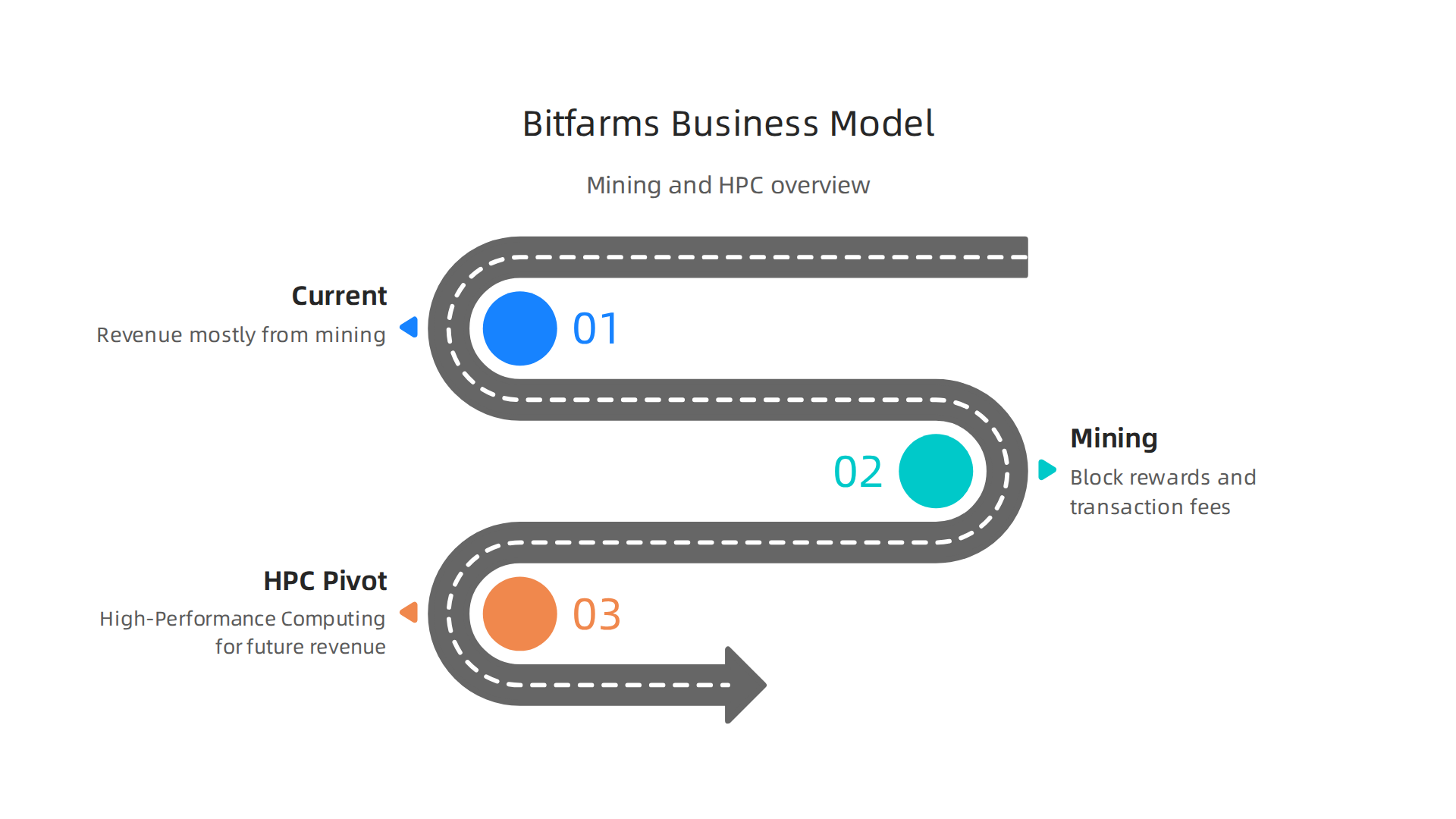
There are two main sources:
- Block Rewards: New Bitcoin created and awarded to them.
- Transaction Fees: Fees paid by users to have their transactions processed.
Their revenue in any period swings with two big factors: the price of Bitcoin (which you can track on any bitcoin stock chart or Bitcoin Yahoo Finance page) and the overall network mining difficulty. When Bitcoin’s price is high, their mined coins are worth more. This direct link to Bitcoin’s price is a source of both opportunity and volatility, a topic we explore in depth regarding BTC volatility and stablecoin trust.
On the cost side, energy is the giant. This is why their focus on cheap power is so critical. Other major costs include buying and maintaining their mining machines (hardware) and building out their facilities (infrastructure).
Their growth strategy involves:
- Geographic Expansion: Building or acquiring sites in energy-advantaged regions.
- Hardware Upgrades: Constantly installing newer, more efficient miners to boost their hash rate while using less power.
- Diversification: Exploring new areas like the HPC business mentioned earlier.
How Bitfarms Stacks Up Against the Competition
In the public mining sector, companies are often compared on a few key metrics:
- Hash Rate: The total computational power. A higher hash rate means a better chance to earn Bitcoin.
- Energy Cost per Coin: How much it costs in electricity to mine one Bitcoin. Lower is better and is a major competitive edge.
- Financial Health: Debt levels, cash on hand, and how efficiently they turn hash rate into profit.
While specific rankings change, Bitfarms has consistently positioned itself as a mid-to-large-tier miner with a strong focus on low-cost, sustainable energy. This operational efficiency is crucial for surviving in the competitive mining industry, especially during periods when Bitcoin’s price is lower.
Understanding a company’s position requires looking beyond just the stock ticker. It involves evaluating their business model, risks, and strategy within the broader market. For a straightforward method to assess crypto-related investments, our guide on which crypto to invest in offers a simple, pillar-based framework.
The world of crypto stocks moves fast. For clear, step-by-step guidance that helps you track companies like Bitfarms and understand market shifts, subscribing to the free Clicks and Trades newsletter is a smart way to stay informed.
Sign Up for straightforward market insights.
Key Investment Thesis and Potential Growth Drivers
So, what makes Bitfarms stock a potential buy for some investors in 2026? The bullish case rests on a few powerful drivers working together: Bitcoin’s price, the company’s own growth, and a new strategic direction.
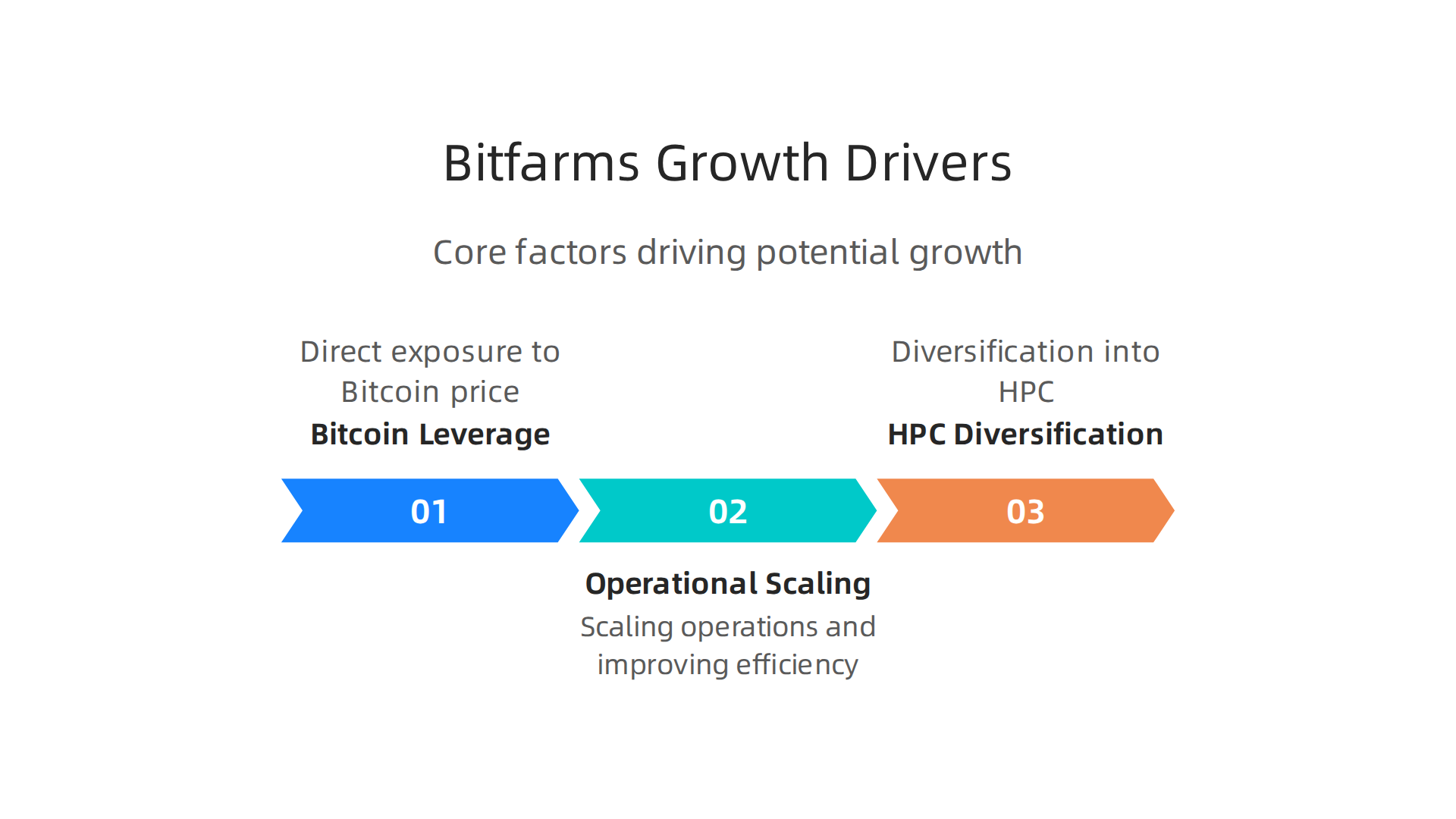
The Core Bullish Drivers
-
Direct Bitcoin Leverage: The most straightforward reason to consider any BTC stock is for amplified exposure to Bitcoin’s price. When Bitcoin rises, the value of the coins Bitfarms mines increases directly. This can lead to outsized gains for the stock compared to the asset itself. You can track this relationship on any bitcoin stock chart or Bitcoin Yahoo Finance page. After Bitcoin reached new highs in 2025, the potential for further appreciation remains a key pillar of the thesis.
-
Operational Scaling and Efficiency: Bitfarms isn’t just sitting still. Their growth plan involves continuously upgrading to more efficient mining machines and expanding into regions with cheap, reliable power. This scaling increases their hash rate, boosting their potential to earn Bitcoin. More importantly, lower energy costs give them a crucial survival edge. A 2026 industry report noted that the average cost to mine one Bitcoin for public miners is high, putting inefficient operators at risk. Bitfarms’ focus on low-cost energy positions it well in this competitive landscape.
-
Diversification into High-Performance Computing (HPC): This is the company’s biggest strategic bet for future growth. As detailed in their Annual Report filed in March 2026, Bitfarms is pivoting from pure Bitcoin mining to also provide computing power for artificial intelligence and other data-intensive tasks. If successful, this could create a new, steady revenue stream that isn’t tied to crypto market cycles.
Specific Catalysts to Watch
- Technology Adoption: The successful deployment of their newest, most efficient mining rigs can immediately boost profitability.
- Favorable Regulation: Clearer and supportive crypto regulations in their operating countries can reduce uncertainty and potentially lower compliance costs.
- Strategic Partnerships: Deals for their new HPC services could be announced, validating their diversification strategy.
Acknowledging and Overcoming Past Challenges
Like many miners, Bitfarms has faced hurdles, including periods of high debt, operational setbacks, and the intense pressure of the 2024 Bitcoin "halving," which cut mining rewards in half. Management has addressed these by focusing on financial discipline, refinancing debt, and relentlessly pursuing low-cost energy contracts. Their pivot to HPC is itself a direct response to the challenge of relying solely on Bitcoin block rewards.
The investment thesis for Bitfarms stock in 2026 balances high-reward Bitcoin exposure with a management team actively de-risking the business through efficiency and diversification. It’s a play on both the crypto market and the company’s own execution. For investors, understanding these drivers is part of smart risk management, much like the thorough approach needed for stablecoin due diligence.
Staying on top of these fast-moving trends in crypto stocks requires clear, timely information. For straightforward analysis and step-by-step guidance, subscribing to the free Clicks and Trades newsletter is a helpful way to keep your research sharp.
Sign Up for clear market insights delivered to your inbox.
A Realistic Look at the Risks: What Could Go Wrong with BITF?

Looking at the growth potential of Bitfarms stock is important, but smart investing also means understanding what could derail that story. Every BTC stock carries unique risks beyond just Bitcoin’s price swings. Let’s break down the key challenges facing Bitcoin miners like Bitfarms in 2026.
1. The Primary Risk: Bitcoin Price Volatility
This is the big one. Bitfarms stock is highly correlated to Bitcoin’s price. When you look at any bitcoin stock chart on Bitcoin Yahoo Finance, you’ll see they often move in sync, but sometimes the stock moves more dramatically. If Bitcoin’s price falls and stays low, the value of Bitfarms’ mined coins plummets. This can crush revenue and profitability, especially if Bitcoin’s price drops below the company’s cost to produce each coin. A 2026 industry analysis noted that some public miners face bankruptcy risk if Bitcoin stays below key price levels for extended periods, highlighting this fundamental pressure. Managing this kind of asset volatility is a core skill, similar to understanding the dynamics covered in our guide on BTC volatility and stablecoin trust.
2. Operational and "Acts of God" Risks
Running a global mining operation is complex and fraught with physical dangers.
- Energy Price Spikes: Miners live and die by their electricity costs. A sudden spike in power prices in one of their key regions can instantly turn a profitable operation into a money-losing one.
- Hardware Failure and Fire: Mining rigs run 24/7 at high temperatures. Hardware fails, and sometimes disaster strikes. In early 2026, miner NFN8 Group filed for Chapter 11 bankruptcy after a massive fire at its Texas facility cut its mining capacity in half, a stark reminder of this physical risk. Another report on the incident confirmed the fire was a primary cause for the filing.
- Rising Network Difficulty: The Bitcoin network automatically adjusts mining difficulty. As more miners join the network, it becomes harder for everyone to earn rewards. If Bitfarms doesn’t continuously upgrade its machines and hash rate, its share of the rewards will shrink.
- Geopolitical Factors: Operations in multiple countries mean navigating different political landscapes, energy policies, and potential regulatory changes.
3. Regulatory and Legal Uncertainty
Governments are still figuring out how to handle crypto mining.
- Changing Rules: A country could suddenly impose prohibitive taxes on mining, restrict energy use for crypto, or even ban it outright. This could force a costly and sudden relocation of operations.
- Legal Disputes: The industry is no stranger to lawsuits. In 2025, the FTX Bankruptcy Trust filed a massive $1.15 billion lawsuit against miner Genesis Digital Assets. Other miners have faced legal actions from partners and creditors. These disputes drain resources and create uncertainty, as seen in other industry legal filings.
4. Corporate and Competitive Risks
- Execution Risk: Bitfarms’ promising plan to diversify into High-Performance Computing (HPC) is just that—a plan. Successfully building a new business line is hard. Delays, cost overruns, or a failure to secure customers could disappoint investors.
- Financial Health: While management has worked on debt, carrying high leverage in a cyclical industry is risky. If Bitcoin enters a prolonged downturn, debt payments can become a severe burden.
- Fierce Competition: Bitfarms isn’t just competing with other public miners. It also faces competition from private miners and large players like Bitmain, which also operates its own mining capacity. The fight for the cheapest power and the best machines is relentless.
The Bottom Line
Investing in any bitcoin stock like Bitfarms is a calculated bet on both Bitcoin’s future and a company’s ability to navigate a minefield of operational and financial risks. The recent bankruptcies of other miners serve as a clear warning of what can go wrong. It requires a clear-eyed view of these challenges as part of your overall method for choosing which crypto to invest in.
Staying informed on both the opportunities and these very real risks is crucial. For clear, step-by-step analysis that helps you make sense of the complex crypto market, consider subscribing to the free Clicks and Trades newsletter. It’s a straightforward resource for building your knowledge safely.
Sign Up for straightforward market insights to help inform your decisions.
How to Analyze Bitfarms Stock: Essential Metrics and Frameworks
Knowing the risks is one thing. Knowing how to spot a strong operator is another. To move beyond just watching the bitcoin stock chart on Bitcoin Yahoo Finance, you need to analyze Bitfarms stock like a pro. This means looking under the hood at the unique metrics that define a miner’s health and future.
Think of it like this: you wouldn’t buy a car just because it’s red. You’d check the engine, fuel efficiency, and maintenance history. Evaluating a BTC stock requires the same diligence. As one 2026 guide notes, it requires a mix of financial benchmarks and operational metrics.
Here’s your framework for 2026.
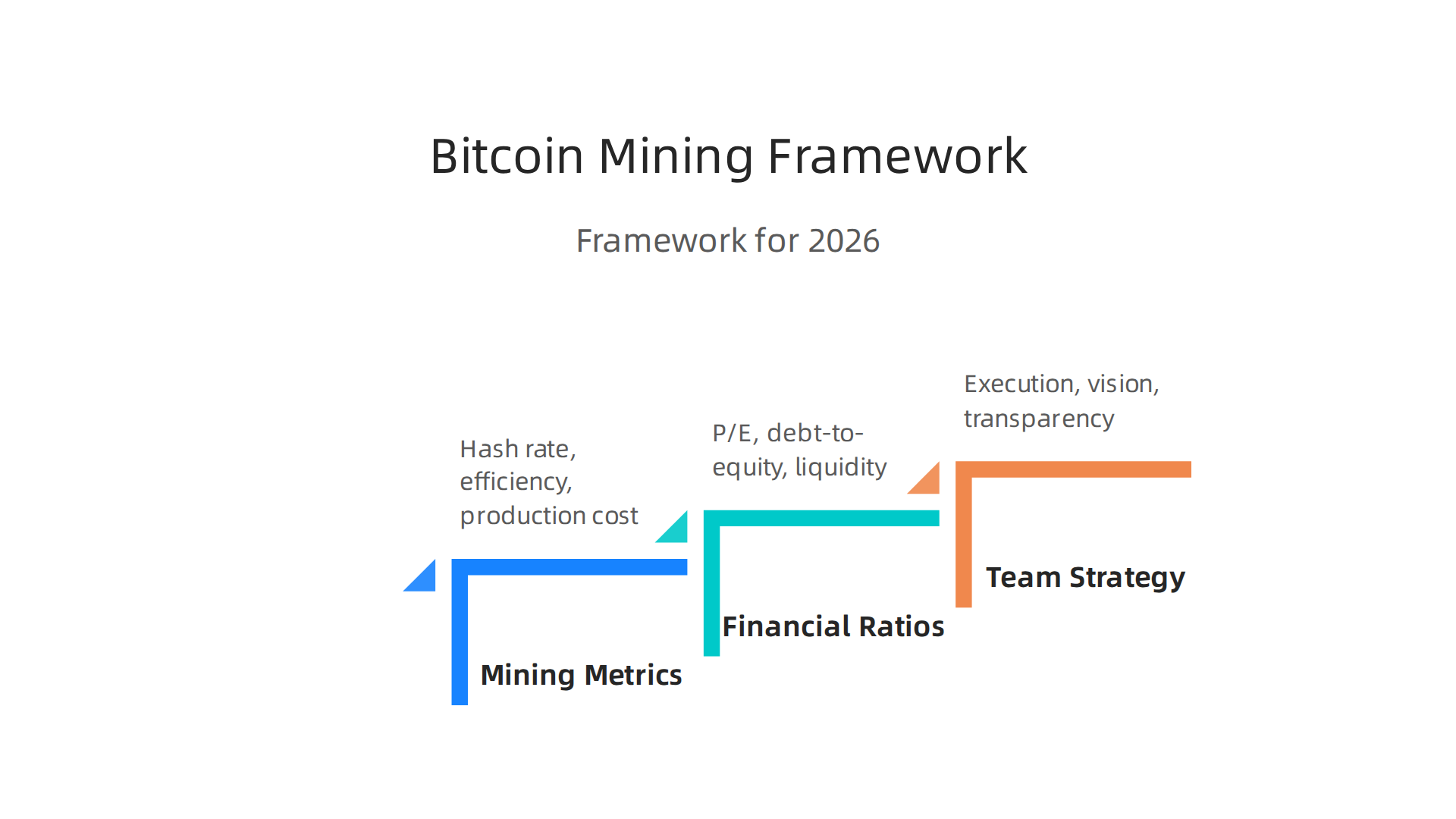
1. The Mining-Specific Dashboard: Beyond the Balance Sheet
These are the numbers that tell you if the mining operation itself is efficient and competitive.
- Hash Rate (EH/s): This is the company’s total computational power. It’s like its "mining muscle." Growing hash rate generally means the company is expanding and can earn more rewards. But watch the trend. Is it growing steadily, or is it flatlining while competitors grow faster?
- Energy Efficiency (J/TH): This is arguably the most critical number. It measures how many joules of energy it takes to produce one terahash. A lower number is better. It tells you who has the newest, most efficient machines and who can mine Bitcoin for the lowest cost. In 2026, the most efficient miners have a massive edge.
- Cost to Produce One Bitcoin: This is the bottom line. It combines all costs: electricity, staff, hosting, etc. You can compare this directly to Bitcoin’s market price. A 2026 report from CoinShares found the weighted average cash cost for public miners was nearly $80,000 in late 2025. If Bitfarms’ cost is significantly below this average and the current Bitcoin price, it has a strong profit buffer. If Bitcoin’s price falls below a miner’s cost for too long, it faces existential risk, as recent analyses of miner bankruptcies have shown.
2. Traditional Financial Ratios: The Context Matters
Standard stock ratios need a miner-specific lens.
- Price-to-Earnings (P/E) Ratio: Be careful here. Mining earnings are wildly volatile based on Bitcoin’s price. A high P/E might mean the stock is expensive, or it might just reflect a recent dip in Bitcoin’s price that temporarily crushed earnings. Look at it over time, not as a single snapshot.
- Debt-to-Equity Ratio: This is crucial. Mining is capital-intensive. Companies borrow to build facilities and buy machines. But too much debt is dangerous in a cyclical industry. A manageable debt level means the company can survive a Bitcoin downturn without being crushed by interest payments. It’s a key part of assessing a company’s long-term stability, similar to how you’d evaluate the foundations of any financial asset in your method for choosing which crypto to invest in.
- Liquidity (Current Ratio): Can the company pay its short-term bills? Look at cash and Bitcoin holdings versus upcoming expenses. Strong liquidity means it can operate smoothly without being forced to sell Bitcoin at a bad time just to keep the lights on.
3. Assessing the Team and Strategy: The "X-Factor"
Numbers don’t run companies, people do. A 2026 guide on mining investments stresses that the best bitcoin mining stocks demonstrate operational excellence, not just Bitcoin price exposure.
- Execution Track Record: Has management delivered on past promises? Did they expand hash rate on schedule? Did they navigate the last market downturn wisely? Look at their history.
- Strategic Vision: Is the plan just "mine more Bitcoin," or is there a smart diversification strategy? For Bitfarms, their push into High-Performance Computing (HPC) is a key strategic bet. Your job is to assess if the management team has the skill to execute this complex pivot. Do they have the right partnerships? Are they securing customer contracts?
- Transparency and Communication: Do they clearly explain challenges and opportunities in earnings calls? Or do they hide behind jargon? Good management is honest about both wins and losses.
Putting It All Together
Your analysis shouldn’t be a single number. It’s the full picture. A company with mediocre hash rate growth but best-in-class energy efficiency might be a better long-term bet than a fast-growing miner with sky-high costs. Strong finances allow a company to survive the bad times and invest in the good times.
Building this analytical skill takes practice, but it’s what separates hopeful speculators from informed investors. For clear, step-by-step breakdowns of complex topics like this, delivered straight to your inbox, consider the free Clicks and Trades newsletter. It’s a straightforward way to build your knowledge with trusted guidance.
Sign Up for straightforward market insights to help inform your decisions.
Portfolio Strategy: How (and If) BITF Fits into a Diversified Plan
So you’ve analyzed the numbers. You understand the risks and the potential. Now comes the real question: if you decide to invest, where does Bitfarms stock fit in your overall portfolio?
Think of your portfolio like a balanced meal.

You have your core staples for steady nutrition (like broad market ETFs), some protein for growth (like large-cap tech stocks), and maybe a small side for extra flavor and potential upside. In 2026, a stock like BITF is that high-potential, high-risk side dish, not the main course.
The Role of Speculative Growth Stocks
Stocks like Bitfarms stock are speculative growth plays. This means their value is tied to future potential and a high-risk, high-reward business model (mining Bitcoin). They are not stable dividend payers. Their job in your portfolio is to provide targeted exposure to a specific trend—in this case, Bitcoin’s price and mining efficiency—with the hope of outsized gains.
Because of this, your allocation should be small and intentional. It should be money you are fully prepared to lose without impacting your financial goals. As one 2026 crypto portfolio guide notes, speculative allocations should be a strategic part of a broader, diversified asset base.
Modeling Your Allocation: Conservative vs. Aggressive
Your position size in a BTC stock like BITF depends entirely on your personal risk tolerance. Here are two simplified models for 2026.
For the Conservative Investor
- You believe in crypto’s future but prioritize capital preservation.
- Your total exposure to all crypto assets (including stocks, ETFs, and tokens) might be 1-5% of your investment portfolio.
- Within that small crypto sleeve, Bitfarms stock would be a very small satellite position. Think 5-15% of your crypto allocation. In a $100,000 portfolio with a 3% ($3,000) total crypto allocation, a BITF position might be $150 to $450.
- This approach keeps the speculative risk contained while still allowing for participation.
For the Aggressive Investor
- You have a higher risk tolerance and are actively building a crypto-focused portfolio.
- Your total crypto allocation might be higher, say 10-20% of your portfolio.
- Following modern portfolio thinking for 2026, you’d still build a core of less volatile assets first. A common framework suggests 40-60% in foundational assets like Bitcoin and Ethereum.
- After establishing that core, you might allocate a portion of the remaining "growth" segment to high-conviction mining stocks. A BITF position here could be 10-25% of your growth allocation. This requires strong conviction in your research, similar to the disciplined approach needed for any high-conviction token selection.
Understanding Correlation and Market Cycles
This is crucial: BITF does not move in lockstep with Bitcoin. It’s a leveraged, operational bet on Bitcoin.
- In a Strong Bull Market: When Bitcoin’s price is rising fast, efficiently run miners like Bitfarms can see their stock prices rise more than Bitcoin. Their profits swell, and investor enthusiasm runs high. Some 2026 analysis even suggests crypto stocks could potentially outperform Bitcoin ETFs in these conditions due to operational leverage.
- In a Downturn or Bear Market: This is when the risk appears. If Bitcoin’s price falls below a miner’s cost of production for an extended time, the stock can fall dramatically more than Bitcoin. The fear of bankruptcy or dilution from emergency fundraising becomes real. The stock becomes highly volatile and correlated with fear, not just Bitcoin’s price.
This asymmetric behavior means BITF can amplify both gains and losses. Your portfolio must be built to withstand the severe downside swings without forcing you to sell other assets at a loss.
Putting It Into Practice
Adding Bitfarms stock to a portfolio in 2026 is an active decision. It’s not a "set and forget" index fund holding. It requires monitoring the metrics we discussed earlier—especially the cost to produce one Bitcoin versus the current Bitcoin stock chart price.
Start small. Use a position size that lets you sleep at night. View it as a tactical holding within a much larger, diversified strategy that can weather crypto’s famous storms.
Building and managing a portfolio with assets like this takes ongoing learning. For clear, step-by-step guidance on navigating these markets, consider the free Clicks and Trades newsletter. It delivers straightforward insights to help you make informed decisions.
Sign Up for trusted market insights to help inform your strategy.
Practical Steps for the Cautious Investor: From Research to Execution
You have a plan for where Bitfarms stock might fit. Now, how do you actually execute it safely? For the cautious investor, the process is just as important as the decision. Here is a straightforward due diligence and action checklist for 2026.
Your Due Diligence Checklist
Before you buy any share, do your homework. This isn’t just about checking the Bitcoin stock chart on Yahoo Finance. It’s about understanding the company itself.
- Find Official Filings: Always start with the source. As a publicly traded company, Bitfarms files regular reports. In the U.S., search for its filings on the SEC’s EDGAR database. In Canada, check SEDAR. These documents contain audited financials, risk factors, and management discussions.
- Track Operational Updates: The mining business changes fast. Bookmark the "News" or "Investors" section on the official Bitfarms website. Follow their press releases for monthly production updates, expansion plans, and energy agreements. This is where you see the operational story behind the BTC stock ticker.
- Follow Analyst Coverage: Don’t rely on social media hype. Seek out professional analysis. Platforms like Bloomberg Terminal offer deep financial data, while other services compile analyst ratings and reports. As noted in a 2026 roundup, using the right stock research websites and tools can significantly simplify your investment research. This disciplined approach is similar to the careful process needed for stablecoin due diligence.
Where to Buy BITF
Once your research is solid, you need a platform to execute the trade.
- Traditional Brokerages: This is the most common route. Major online brokers (like Fidelity, Charles Schwab, or Interactive Brokers) allow you to buy BITF just like any other stock. You use your existing investment account, and the process is familiar.
- Crypto Exchanges (Some): A growing number of cryptocurrency exchanges now offer traditional stock trading, including some mining stocks. This can be convenient if you already hold crypto there, but be sure to understand the platform’s regulations, fees, and insurance policies before using it for stocks.
Tax Implications and Record-Keeping
This part is not exciting, but it’s critical.
- Capital Gains: In most jurisdictions, profits from selling Bitfarms stock are subject to capital gains tax. The rate often depends on how long you held the asset (short-term vs. long-term). This is a major reason why "buy and hold" is a common strategy.
- Secure Record-Keeping: Keep impeccable records. Save your trade confirmations, monthly account statements, and any documents related to corporate actions. This makes tax season much easier and is essential for tracking your true cost basis and performance. For complex portfolios, some investors use dedicated due diligence software to organize their research, though for most individuals, a simple, well-organized digital folder is sufficient.
Taking these practical steps transforms a speculative idea into a managed investment. It’s about moving from curiosity to controlled action. The crypto market requires continuous learning to stay informed. For clear, step-by-step guidance delivered to your inbox, consider the free Clicks and Trades newsletter. It’s a straightforward resource for navigating these markets.
Ready to build your knowledge base? Sign Up for trusted insights to inform your strategy.
Summary
This article applies the same rigorous, evidence-focused due diligence used for stablecoins to publicly traded crypto stocks, using Bitfarms (BITF) as a case study. It explains Bitfarms’ business model—how mining rewards, transaction fees, hash rate and energy costs drive revenue—and highlights the company’s strategic pivot into high-performance computing (HPC). The guide lays out the core metrics investors must track (hash rate, energy efficiency, cost-to-produce, debt levels and liquidity), describes the main risks (Bitcoin volatility, operational hazards, regulation and execution), and shows how to size a position inside a diversified portfolio. It also gives a practical checklist for research, where to find filings and how to execute trades, plus tax and record-keeping reminders. After reading, you’ll have a clear framework to evaluate Bitfarms and similar miners, understand when the stock benefits from Bitcoin moves, and know the steps to research and buy shares responsibly.